
Great Wall
만리장성
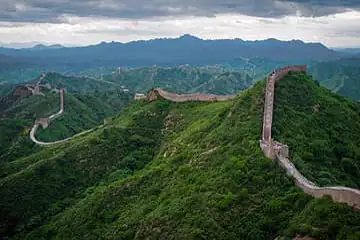
The Great Wall of China is not one single wall but a long chain of walls, towers and forts across northern China. Chinese states and empires built it over many centuries to guard their northern borders against nomadic peoples, groups who moved from place to place across the grasslands of the Eurasian steppe. The first walls date back to the 7th century BC, and the best-known stone and brick sections were built by the Ming dynasty, which ruled from 1368 to 1644.
See it on the 3D globe →At a glance
- Country
- China
- Location
- Northern China
- Built
- 7th c. BC – 1644
- Type
- Fort
Quick answers
Where is Great Wall?
Great Wall is in Northern China.
Fortifications built over many centuries to guard China's northern frontier, stretching thousands of kilometres.
Counting every branch and section ever built, a 2012 Chinese government survey measured about 21,196 km of wall, stretching from the east coast near Liaodong to Lop Lake in the far west. It is a UNESCO World Heritage Site and was voted one of the New 7 Wonders of the World in 2007.
History
Before China was one country, rival states built their own walls to defend their borders. Some of the oldest surviving pieces are made of rammed earth, soil packed down hard, and are about 2,500 years old. Around 220 BC, the First Emperor, Qin Shi Huang, united China and joined many of these walls together. Later dynasties repaired and extended them. The Ming emperors rebuilt large parts in brick and stone and added watchtowers. In 1644 the Manchus passed through the wall at Shanhai Pass and took Beijing, and after that the wall mattered much less for defence.
How it worked
The wall was more than a barrier. Soldiers lived in barracks and garrison stations along it, and watchtowers let guards look far across the land. To send warnings quickly, they lit smoke or fire signals from tower to tower. Between 1567 and 1570, under General Qi Jiguang, about 1,200 watchtowers were built near Beijing alone. The wall also worked like a border checkpoint, controlling who came and went and collecting taxes on goods carried along the Silk Road trade routes.
How long is it?
The answer depends on what you count. A 2012 survey by China's National Cultural Heritage Administration found that the Ming-era Great Wall alone measures about 8,850 km, including trenches and natural barriers such as hills and rivers. Adding every older wall and trench from earlier dynasties brings the total to about 21,196 km. Some encyclopedias give shorter figures, around 4,000 to 5,500 km, for the main line of wall. Either way, it is one of the largest building projects in human history.
Fun facts
- Counting all its branches, the wall measures about 21,000 km, according to a 2012 Chinese survey.
- Builders often held the bricks together with mortar made from sticky rice soup mixed with lime.
- Despite the popular myth, you cannot see the Great Wall with your bare eyes from the Moon, and it is very hard to spot even from low orbit because it is narrow and blends into the land around it.
- Badaling, near Beijing, was the first section opened to visitors and had nearly 10 million visitors in 2018.
- The Chinese name 万里长城 means "the ten-thousand-li long wall"; a li is an old Chinese unit of distance.
On the globe
The model shows a long stretch of the wall snaking along the hills of northern China, with watchtowers along its length. Follow it with your eyes to see how it climbs and dips with the land.
Nearby on the globe





Sources
- Read more on Wikipedia
- Great Wall of China — Wikipedia
- The Great Wall of China — National Geographic Education
Updated: 2026-10-13