
Imperial City of Huế (Meridian Gate)
후에 황성 (오문)
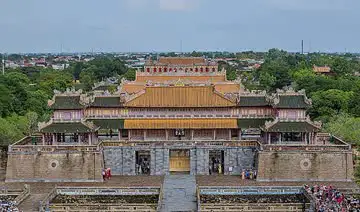
The Imperial City of Huế, also called Đại Nội, is a royal walled enclosure inside the citadel of Huế, the former imperial capital of Vietnam during the Nguyễn dynasty. It holds palaces for the imperial family, shrines, gardens and offices for officials. It was built from 1804 under Emperor Gia Long, enlarged to its present size in 1833, and became a UNESCO World Heritage Site in 1993 as part of the Complex of Huế Monuments.
See it on the 3D globe →At a glance
- Country
- Vietnam
- Location
- Huế, Vietnam
- Built
- 1833
- Type
- Palace
Quick answers
Where is Imperial City of Huế (Meridian Gate)?
Imperial City of Huế (Meridian Gate) is in Huế, Vietnam.
When was Imperial City of Huế (Meridian Gate) built?
Imperial City of Huế (Meridian Gate) was built in 1833.
Walled citadel of the Nguyễn emperors; its Meridian Gate is topped by the yellow-roofed Five Phoenix Pavilion.
Gia Long, who united Vietnam in 1802, modelled the palace on Beijing's Forbidden City, but the Huế citadel faces southeast toward the Perfume River rather than true south, and the imperial residence sits off to that side, close to the river. It was the seat of power until the French protectorate in the 1880s, and afterwards mostly kept symbolic traditions alive. The last emperor, Bảo Đại, gave up the throne here on 30 August 1945.
A giant citadel
The citadel was surveyed in 1803 and building went on from 1805 until 1832 under Emperor Minh Mang. Tens of thousands of people took part over about 30 years, moving millions of cubic metres of earth and rock. It is built in the Vauban style, with zigzag walls almost 10 kilometres around, and surrounded by a moat. Geomancers chose the site: the flat-topped Ngự Bình Mountain stands in front like a natural screen, with two small river islands on either side.
Inside the Imperial City
A second set of tall walls and a second moat surround the Imperial City itself. Inside are gated courtyards, gardens, pavilions and palaces. Only the emperor's family could live in the citadel, and commoners were not allowed in, apart from court ladies, eunuchs and soldiers who served there. Officials and students of the imperial academy could enter during working hours.
Damage and rebuilding
After the monarchy ended, the palace suffered from neglect, termites and cyclones. The worst damage came from wars. In 1947 the Việt Minh seized the Citadel and much was lost, and fighting in the 20th century left bullet holes that can still be seen. Restoration work is going on today.
Fun facts
- Its inner Purple Forbidden City was modelled on Beijing's Forbidden City.
- The citadel's walls are almost 10 kilometres around and zigzag in shape.
- The palace was modelled on the Forbidden City, but it faces the Perfume River.
- Emperor Bảo Đại ended the monarchy here on 30 August 1945.
- Bullet holes from 20th-century fighting can still be seen on its walls.
On the globe
The model shows the walled palace with its Meridian Gate and yellow-roofed pavilion. Look for the two-story gate.
Quiz time
Which is older: Imperial City of Huế (Meridian Gate) or Bayon?
Show the answer
Bayon. (1833 vs 1200) Bayon →
Nearby on the globe





Sources
Updated: 2026-10-14