
Ha Long Bay
하롱베이
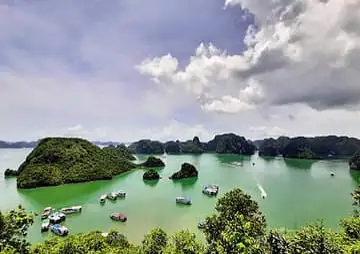
Ha Long Bay is a bay in Quảng Ninh province in northeastern Vietnam, on the Gulf of Tonkin. About 1,600 to nearly 2,000 islands and islets rise out of its green water, depending on how they are counted. Most are steep towers of limestone topped with jungle, and many are hollow inside, with large caves. The whole bay covers about 1,550 square kilometres.
See it on the 3D globe →At a glance
- Country
- Vietnam
- Location
- Quảng Ninh, Vietnam
Quick answers
Where is Ha Long Bay?
Ha Long Bay is in Quảng Ninh, Vietnam.
Thousands of limestone islands and pillars rising from emerald water.
The name Hạ Long means "descending dragon". UNESCO first listed the bay as a World Heritage Site in 1994 for its beauty, and again in 2000 for what its rocks tell us about Earth's history. The protected area was later extended to take in the nearby Cat Ba Archipelago. Today Ha Long Bay is one of Vietnam's best-known sights, visited by millions of people a year, mostly on boat trips between the islands.
How the islands formed
The limestone here took shape over about 500 million years. Limestone slowly dissolves in rainwater, and over about 20 million years the warm, wet tropical climate ate it into a landscape called karst: clusters of cone-shaped peaks and lonely rock towers with caves inside. Later the sea rose and flooded the low ground between the towers, leaving only their tops standing above the water. Some islands even hold small salty lakes, called marine lakes, in sunken hollows inside them.
Caves and floating villages
Many islands hide caves full of stalactites and stalagmites, rock icicles that grow from the ceiling and floor as dripping water leaves minerals behind. The largest is Đầu Gỗ, the Wooden Stakes Cave; French visitors in the 19th century called it the Grotto of Wonders. Only about 40 of the islands have people living on them. Around 1,600 people live in fishing villages built on the water itself, in houses on rafts, where they catch fish and raise seafood in floating pens.
The legend of the dragons
A Vietnamese legend says that long ago, when invaders sailed toward the country, the gods sent a family of dragons to help. The dragons spat out jewels and jade, which became the islands and formed a stone wall in the sea that wrecked the enemy ships. After the battle, the dragons liked the place so much that they stayed, and the spot where the mother dragon came down was named Hạ Long. History has its own sea battles here too: in 1288 a Vietnamese general stopped a Mongol fleet in a nearby river with hidden wooden stakes.
Fun facts
- Its name means 'descending dragon'.
- Ha Long Bay and the nearby Cat Ba islands contain about a third of all the world's marine lakes, salty lakes hidden inside islands.
- The Cat Ba langur, a monkey found only here, is critically endangered: its numbers have fallen by about 97 percent since the 1960s.
- About 1,000 kinds of fish have been recorded in the waters of the bay and the Cat Ba islands.
- Many of the islands got their names from their unusual shapes.
On the globe
The model shows a cluster of limestone islands and rock pillars rising from emerald water in northern Vietnam. Zoom in and look at how steep and narrow the rocky towers are.
Nearby on the globe

Sources
- Read more on Wikipedia
- Hạ Long Bay — Wikipedia
- 할롱만 — 위키백과
- Ha Long Bay - Cat Ba Archipelago — IUCN World Heritage Outlook
Updated: 2026-10-13