
Ishtar Gate, Babylon
이슈타르의 문 (바빌론)
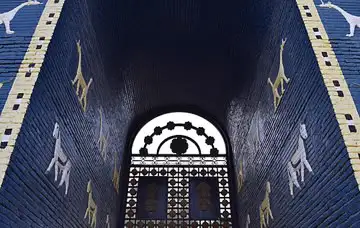
The Ishtar Gate was the eighth gate in the inner wall of ancient Babylon, in what is now Hillah in Iraq. King Nebuchadnezzar II ordered it built around 569 BC on the north side of the city, and dedicated it to the goddess Ishtar. It was part of a grand processional way, a road for religious parades, that led into the city.
See it on the 3D globe →At a glance
- Country
- Iraq
- Location
- Babylon, Iraq
- Built
- -569
- Type
- Monument
Quick answers
Where is Ishtar Gate, Babylon?
Ishtar Gate, Babylon is in Babylon, Iraq.
When was Ishtar Gate, Babylon built?
Ishtar Gate, Babylon was built in 569 BC.
Babylon's northern gate built by Nebuchadnezzar II, faced with blue glazed bricks bearing rows of aurochs and mushhushshu dragons.
The gate was 15 metres high, with foundations reaching another 14 metres underground. Its walls were covered in glazed bricks, mostly vivid blue, with rows of animals and gods in low relief. The German archaeologist Robert Koldewey led the excavation from 1904 to 1914, and after the First World War the smaller front gate was rebuilt in the Pergamon Museum in Berlin. Other panels are in museums around the world.
Dragons, bulls and lions
The gate's reliefs show three animals. The mušḫuššu, a dragon with a snake-like head and tail, stood for the god Marduk. The aurochs, an extinct wild ancestor of cattle, stood for the storm god Adad. The lion stood for Ishtar. The processional way beside it was lined with about 120 lions, bulls, dragons and flowers on yellow and black bricks, and sixty lions decorated each side. Every lion was made of forty-six moulded bricks.
How the blue bricks were made
The bricks were made from fine clay pressed into wooden forms, and the animals from reusable moulds. The seams were planned so they never cut across an animal's eyes. The bricks were dried, fired once, painted with glaze and fired again. The blue glaze was meant to look like lapis lazuli, a deep-blue stone prized in ancient times. Cobalt was added to the glaze. The bricks were laid with very thin seams of one to six millimetres, sealed with bitumen, a natural tar. Over 15 million baked bricks are estimated to have decorated Babylon.
The New Year parade
Once a year the gate and the processional way were used for a New Year procession, a religious festival that celebrated the start of the farming year. It lasted twelve days and began just after the barley harvest, around 20 or 21 March. Statues of the gods were carried through the gate and down the road, which was traced for over 800 metres. The festival was meant to affirm the power of Marduk and the king, and to give thanks for the land's fertility.
Fun facts
- A reconstruction of the gate stands in the Pergamon Museum in Berlin.
- The gate's roof and doors were made of cedar, according to the dedication plaque.
- The processional way was traced to a length of over 800 metres.
- The Iraqi embassy in Beijing has a replica of the Ishtar Gate on its facade.
- Each lion on the processional way was made of 46 moulded bricks in eleven rows.
On the globe
The model shows the blue gate with rows of dragons and bulls on its walls.
Quiz time
Which is older: Ishtar Gate, Babylon or Al-Shaheed Monument?
Show the answer
Ishtar Gate, Babylon. (569 BC vs 1983) Al-Shaheed Monument →
Nearby on the globe

Sources
Updated: 2026-10-14