
Great Ziggurat of Ur
우르의 지구라트
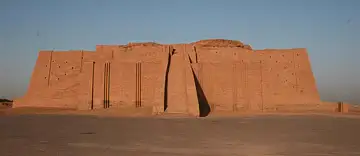
The Great Ziggurat of Ur is a giant stepped temple platform in southern Iraq, near the modern city of Nasiriyah. It was built about 4,100 years ago, in the 21st century BC, by King Ur-Nammu of the Third Dynasty of Ur, and finished by his son Shulgi. It was dedicated to Nanna, the moon god and protector of the city of Ur.
See it on the 3D globe →At a glance
- Country
- Iraq
- Location
- near Nasiriyah, Iraq
- Built
- -2100
- Height
- 30 m
- Type
- Religious building
Quick answers
Where is Great Ziggurat of Ur?
Great Ziggurat of Ur is in near Nasiriyah, Iraq.
When was Great Ziggurat of Ur built?
Great Ziggurat of Ur was built in 2100 BC.
How tall is Great Ziggurat of Ur?
Great Ziggurat of Ur is about 30 m tall.
A massive stepped temple platform built for the moon god Nanna around 2100 BC, its three great stairways meeting at the front.
A ziggurat is a stepped tower with a temple on top, and it was the most distinctive kind of building in ancient Mesopotamia, the land between the Tigris and Euphrates rivers. Ur's ziggurat is one of the best preserved in the region. Its base measures about 64 by 45 metres, and it may once have stood around 30 metres tall, so it would have been the highest point in the city and visible for miles across the flat land.
How it was built
The core of the ziggurat is a solid mass of mud brick, sun-dried bricks made of clay. It was covered with a tougher skin of baked bricks stuck together with bitumen, a natural tar. The lowest level alone may have used about 720,000 baked bricks, some weighing up to 15 kilograms each. The builders were clever: they left small holes through the outer layer so water could dry out of the damp core, and they built drains on the terraces to carry away winter rain.
What it was for
Three huge staircases led up to a gateway on the first terrace. From there more steps climbed to a temple for Nanna at the very top. The ziggurat stood inside a temple complex that also worked as the city's centre of government. People probably brought extra crops there as offerings and received their regular food rations, so a visit fed both the spirit and the stomach. The top temple has not survived.
Ruins and rebuilding
By the 6th century BC the ziggurat had crumbled, and Nabonidus, the last king of Babylon, rebuilt its upper levels. In the 1920s and early 1930s the archaeologist Sir Leonard Woolley, working for the University of Pennsylvania Museum and the British Museum, uncovered it fully. In the 1980s the front wall of the lowest level and the three great staircases were rebuilt, which is why that part looks so neat today. The site was damaged during the 1991 Gulf War, and bullet holes can still be seen in its walls.
Fun facts
- It was built by King Ur-Nammu for the moon god Nanna.
- The ziggurat's Sumerian name, Etemenniguru, means "house whose foundation creates terror".
- Builders left holes in the outer brick skin so the damp mud-brick core could "breathe".
- Some of its baked bricks weighed up to 15 kilograms each.
- The ziggurat has been restored twice: once by a Babylonian king about 2,500 years ago, and again in the 1980s.
On the globe
The model shows the massive stepped platform built for the moon god Nanna, with its three great stairways meeting at the front. Zoom in to follow the staircases up to the gateway on the first terrace.
Quiz time
Which is taller: Great Ziggurat of Ur or Kuwait Towers?
Show the answer
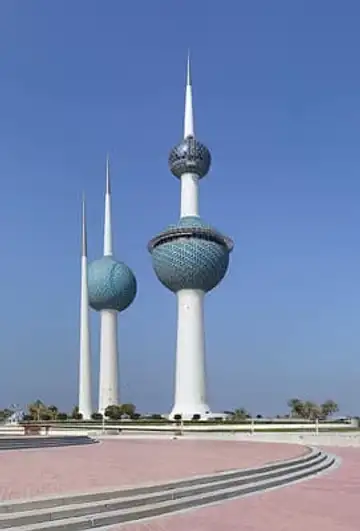
Kuwait Towers. (30 m vs 187 m) Kuwait Towers →
Nearby on the globe



Sources
- Read more on Wikipedia
- Ziggurat of Ur — Wikipedia
- 우르의 지구라트 — 위키백과
- Ziggurat of Ur (Dr. Senta German, Smarthistory/Khan Academy) — Lumen Learning, Art History I
Updated: 2026-10-13