
Lençóis Maranhenses
렌소이스 마라녜시스
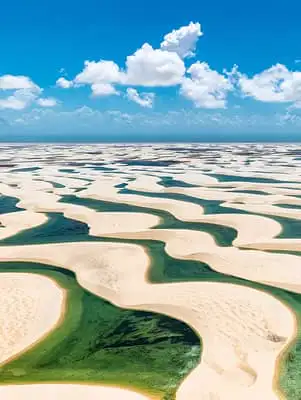
Lençóis Maranhenses National Park is a huge area of white sand dunes on the northeast coast of Brazil, in the state of Maranhão. It covers about 155,000 hectares (1,550 square kilometres) and has 70 kilometres of Atlantic beaches. It looks like a desert, but it is not.
See it on the 3D globe →At a glance
- Country
- Brazil
- Location
- Maranhão, Brazil
- Type
- Park
Quick answers
Where is Lençóis Maranhenses?
Lençóis Maranhenses is in Maranhão, Brazil.
White sand dunes that fill with turquoise rainwater lagoons each rainy season.
About 1,200 millimetres of rain fall each year, far more than the 250 millimetres or less that defines a true desert. In the rainy season turquoise lagoons appear between the dunes. The park was protected in 1981 and UNESCO named it a World Heritage Site in July 2024 for its exceptional beauty and unique landscape. Its name comes from the Portuguese word for bed sheets, because the pale dunes look like sheets spread out to dry.
Why does a sand desert have lakes?
Most of the rain falls between January and May. It fills the hollows between the dunes with fresh water, and a layer of rock under the sand stops it from draining away. The lagoons can reach 100 metres in length and 3 metres in depth, and together they can cover up to 41 percent of the park. Their water is warm, around 27 to 32 degrees Celsius. When the dry season returns, the pools evaporate quickly, losing as much as a metre of depth each month.
How the dunes formed
The rivers Parnaíba and Preguiças carry sand from inland to the sea. Winds then push it back onto the land, as far as 50 kilometres from the coast, building crescent-shaped dunes up to 40 metres tall. These dunes formed in the late Quaternary period, the most recent chapter of Earth's history.
Life in the dunes
Fish live in the lagoons, including the wolf fish, which burrows into wet mud and stays dormant through the dry season. The park also has two green oases of plants called restingas, plus mangroves. It is home to 112 bird species and at least 42 reptiles, and four of its animals are listed as endangered in Brazil: the scarlet ibis, the neotropical otter, the oncilla and the West Indian manatee. About 60,000 visitors come each year, and some of the scenery has appeared in films.
Fun facts
- Though it looks like a desert, it gets plenty of rain, which fills lagoons between the dunes each year.
- About 1,200 millimetres of rain fall each year, far more than a true desert gets.
- The lagoons can cover up to 41 percent of the park in the wet season.
- The dunes rise up to 40 metres high.
- A fish called the wolf fish sleeps in the mud through the dry season.
On the globe
The model shows rolling white dunes with turquoise lagoons between them.
Nearby on the globe







Sources
Updated: 2026-10-14