
Leptis Magna
렙티스 마그나
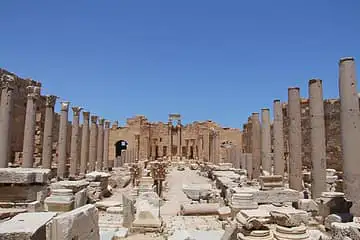
Leptis Magna is the ruin of a great ancient city on the Mediterranean coast of Libya, in North Africa. It lies near the modern town of Al-Khums, about 130 kilometres east of the capital, Tripoli, where a small river valley called the Wadi Lebda meets the sea. It is often described as one of the best-preserved Roman sites in the Mediterranean.
See it on the 3D globe →At a glance
- Country
- Libya
- Location
- Al-Khums, Libya
- Built
- 7th c. BC
- Type
- Ancient site
Quick answers
Where is Leptis Magna?
Leptis Magna is in Al-Khums, Libya.
Spectacular Roman city ruins on the Mediterranean, birthplace of Emperor Septimius Severus.
The city began as a trading post set up by Phoenician sailors from the city of Tyre in the 7th century BC. Later it came under the control of Carthage and then of Rome. It grew rich from olive oil and from trade with Africa across the Sahara. Its greatest moment came when a man born here, Septimius Severus, became Roman emperor in 193 AD and filled his hometown with grand new buildings. At its height in the early 200s AD, about 100,000 people may have lived here. UNESCO made it a World Heritage Site in 1982.
History
Leptis was already an old town when it joined the Roman world. Under the emperor Augustus, a wealthy local man paid for a theatre and a covered market, and later emperors added baths and an aqueduct. Septimius Severus, born here on 11 April 145 AD, ruled from 193 to 211 and gave the city a huge new forum, a vast basilica, a rebuilt harbour and a colonnaded street. He visited his hometown in the early 200s, and a four-sided triumphal arch stands in his honour.
What's there to see
Walking through Leptis Magna, you can still see paved streets, the Arch of Septimius Severus, the Severan forum and basilica, the theatre with its columned stage, large public baths and a market with two round halls. One of the market's stones is carved with standard Roman measures, used so shoppers were not cheated. An amphitheatre, built under the emperor Nero, lies a short way to the east.
Buried by sand
After its golden age the city slowly declined. Raids, a tsunami in 365 AD and the Vandal conquest in 439 damaged it, and by the 600s it was nearly empty. Over the centuries, sand dunes blew in and covered much of it, which actually protected the buildings, mosaics and wall paintings from wind and weather. Italian archaeologists began digging it out in the 1920s. Today the ruins are threatened by rising seas and coastal erosion.
Fun facts
- The Roman emperor Septimius Severus was born in Leptis Magna in 145 AD.
- A carved stone in the old market shows official Roman measures so traders could check they were fair.
- Sand dunes buried parts of the city for many centuries, which kept them well preserved.
- Julius Caesar once fined the city three million pounds of olive oil every year.
On the globe
The model shows spectacular Roman city ruins on the Mediterranean shore of Libya. Zoom in on the North African coast east of Tripoli to find it.
Nearby on the globe
_(8288918733).jpg)
Sources
- Read more on Wikipedia
- Leptis Magna — Wikipedia
- Leptis Magna — World History Encyclopedia
- Septimius Severus — Wikipedia
Updated: 2026-10-13