
Antikythera wreck
안티키티라 난파선
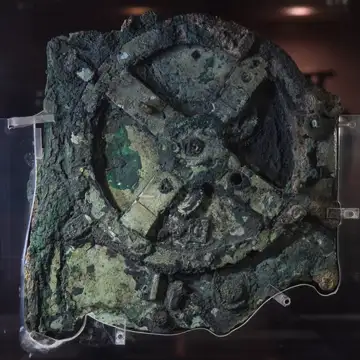
About 50 m down off the Greek island of Antikythera lies a Roman-era cargo ship that sank some 2,000 years ago, in the 1st century BC. Sponge divers stumbled on it in 1900, and bronze and marble statues and clay jars (amphorae) were brought up. Inside a corroded lump of bronze was the Antikythera mechanism, a box of more than 30 interlocking gears that worked out the movements of the Sun and Moon and predicted eclipses; it is called the world's oldest known computer.
See it on the 3D globe →At a glance
- Country
- Greece
- Kind
- Shipwrecks
Quick answers
Where is Antikythera wreck?
Antikythera wreck is in Greece.
The Antikythera wreck is a Roman-era ship that sank in the second quarter of the first century BC near the small Greek island of Antikythera. Sponge divers found it in 1900 off Point Glyphadia, and it turned out to be full of treasures: bronze and marble statues, coins, glassware and a bronze lyre. Some of the objects date back to the fourth century BC.
The most famous find is a badly corroded lump that hid a device of gears, now called the Antikythera mechanism. Many people regard it as the world's oldest known analog computer. The wreck lies in deep water, and its finds are displayed in the National Archaeological Museum in Athens.
How it was found
Around Easter 1900, Captain Dimitrios Kondos and his crew of sponge divers from Symi stopped at Antikythera to wait for good winds. Diver Elias Stadiatis went down to about 45 metres and quickly signalled to be pulled up, telling of a heap of rotting bodies and horses on the sea floor. Kondos thought he was drunk on nitrogen from the air he breathed.
Kondos dived himself and came up with the arm of a bronze statue. The Greek navy then helped to recover objects from November 1900 through 1901. The work was dangerous: one diver died and two were paralysed by decompression sickness, which ended the work in the summer of 1901.
What came out of the sea
By the middle of 1901 divers had brought up bronze statues, including the Youth of Antikythera from about 340 BC, thirty-six marble sculptures such as Hercules, Odysseus, Hermes and Apollo, three marble horses, a bronze lyre and pieces of glass. Even a set of lead sounding weights came up, the only ones ever found on an ancient wreck in the Aegean.
The mechanism was noticed on 17 May 1902, when the archaeologist Valerios Stais saw a gear wheel and Greek writing stuck in a corroded lump of bronze.
When did the ship sink, and what happened next?
Some people guessed the ship carried treasure taken by the Roman general Sulla in 86 BC. But coins found in the 1970s were made between 76 and 67 BC, which ruled that out. Jars and pottery also point to the early first century BC. A hull plank tested in 1964 gave an older date, which experts explain by saying the wood came from an old tree.
Jacques Cousteau visited in 1953 and returned in 1976, when a team recovered nearly 300 more objects. A new five-year survey began in 2021.
Fun facts
- Sponge divers found the wreck in 1900, but nobody noticed the gears of the Antikythera mechanism inside a lump of corroded bronze until 1902.
- Divers first thought the statues on the sea floor were drowned people and horses.
- The gears of the Antikythera mechanism were not noticed until 1902, two years after the wreck was found.
- The ship sank roughly 2,000 years ago, yet some of its statues were made in the fourth century BC.
- A hull plank tested in 1964 looked 150 years older than the wreck, probably because it came from an old tree.
On the globe
The model shows an ancient shipwreck on the seabed near the Greek island of Antikythera.
Quiz time
Which is older: Antikythera wreck or Palace of Knossos?
Show the answer
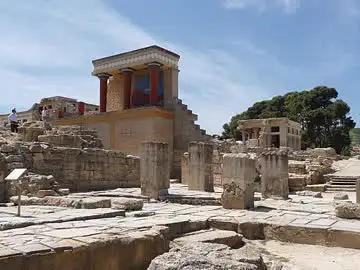
Palace of Knossos. (65 BC vs 1900 BC) Palace of Knossos →
Nearby on the globe


.webp)
Sources
Updated: 2026-10-14