
Masada
마사다
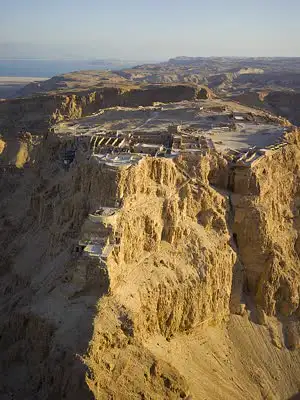
Masada is a fortress on top of a rock plateau in the Judaean Desert in Israel, overlooking the Dead Sea. The flat top is about 550 metres by 270 metres, and cliffs drop roughly 400 metres on the east side, so natural paths up are few and hard. King Herod the Great turned it into a palace-fortress with two palaces, storerooms, cisterns and baths.
See it on the 3D globe →At a glance
- Country
- Israel
- Location
- Dead Sea coast, Israel
- Built
- -31
- Type
- Fort
Quick answers
Where is Masada?
Masada is in Dead Sea coast, Israel.
When was Masada built?
Masada was built in 31 BC.
Herod’s clifftop fortress above the Dead Sea, where the Roman siege ramp of AD 73–74 still stands.
Masada is best known for the Roman siege in 73 or 74 CE, at the end of the First Jewish-Roman War. Roman troops built a huge ramp to reach the walls. The Jewish historian Josephus wrote that 960 defenders died rather than surrender, though historians still debate this. UNESCO made Masada a World Heritage Site in 2001, and about 750,000 people visit each year.
Herod's mountaintop palace
According to Josephus, Herod built the fortress between 37 and 31 BC as a refuge in case of revolt. He added a 4-metre-high double wall about 1,300 metres long with towers, storerooms, barracks, an armory, bathhouses and two palaces, one of them stepped down three terraces of the northern cliff. A system of cisterns held about 40,000 cubic metres of rainwater, and a single day's runoff could reportedly supply over 1,000 people for two to three years.
The Roman ramp and the debate
In 66 CE a group of Jewish rebels, the Sicarii, took the fortress, and later the Roman governor Lucius Flavius Silva brought the Tenth Legion. The Romans built a wall around the rock and then a ramp on the western side. Geologists found that most of the 114-metre ramp is a natural spur of rock. Josephus's account does not match the digs perfectly: remains of at most 28 bodies have been found, so some details are still argued about.
What archaeologists found
Yigael Yadin led digs here in the 1960s. They uncovered Herod's palaces, storerooms with food remains, ritual baths, a synagogue, scroll fragments, and pottery with names on it, one reading 'ben Ya'ir'. A small Byzantine church shows that monks also lived at Masada later. The Roman camps and siege works around the rock are among the best-preserved examples of Roman military engineering, and they were a main reason for UNESCO's listing.
Fun facts
- Masada's cliffs drop about 400 metres toward the Dead Sea.
- The Roman siege ramp is still there after almost 2,000 years.
- Visitors can climb the Snake Path or take a cable car.
- Almost everything we know about the siege comes from one writer, Josephus.
On the globe
The model shows the fortress on its cliff-top plateau. Look for the ramp on the west side.
Quiz time
Which is older: Masada or Western Wall?
Show the answer
Masada. (31 BC vs 19 BC) Western Wall →
Nearby on the globe

Sources
Updated: 2026-10-14