
Petra – Al-Khazneh
페트라 (알카즈네)
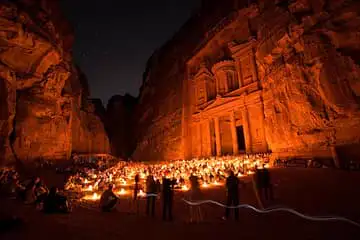
Al-Khazneh, which means "the Treasury" in Arabic, is the most famous monument in Petra, an ancient city in the desert of southern Jordan. It is not a building made of stacked stones: its whole front, with columns, statues and a decorated urn, was carved straight into a cliff of rose-red sandstone. Most experts think it was made in the early 1st century AD, probably as a royal tomb during the reign of the Nabataean king Aretas IV.
See it on the 3D globe →At a glance
- Country
- Jordan
- Location
- Petra, Jordan
- Built
- 1st c. AD
- Height
- 39 m
- Type
- Ancient site
Quick answers
Where is Petra – Al-Khazneh?
Petra – Al-Khazneh is in Petra, Jordan.
How tall is Petra – Al-Khazneh?
Petra – Al-Khazneh is about 39 m tall.
An ornate temple facade carved into rose-red sandstone by the Nabataeans, the icon of Petra.
The Nabataeans were Arab traders who grew rich from caravans carrying incense and spices across the desert, and Petra was their capital. Today Petra is Jordan's most visited attraction. It became a UNESCO World Heritage Site in 1985 and was voted one of the New Seven Wonders of the World in 2007.
Why is it called the Treasury?
The name comes from a legend. Bedouin people who lived in the area believed that the stone urn high on the upper level hid treasure, so they called the monument al-Khazneh, the Treasury, in the early 1800s. Another story said a pharaoh had made it by magic to hide his riches. In fact the urn is solid stone, and there was never any gold inside. Behind the grand front, the inside is surprisingly plain: one main room and three smaller side rooms cut into the rock.
The rose-red city
Petra gets its nickname, the Rose City, from the pink and red colours of its sandstone cliffs. The Nabataeans settled the area around the 4th century BC and made it their capital by the 2nd century BC. To survive in the desert they built dams, cisterns and channels that caught flash floods and stored water for dry months. At its peak about 20,000 people may have lived there. Rome took over the kingdom in AD 106, and a strong earthquake in 363 and changing trade routes later led to its decline.
Visiting today
Visitors reach the Treasury through the Siq, a narrow, winding canyon with towering walls. At the end of the path, the carved front suddenly appears through the gap. So many people now visit that crowds, extra humidity and touching hands are wearing the soft stone away, which makes protecting it a big concern. In 2019 alone, more than 1.1 million people visited Petra.
Fun facts
- The stone urn on the Treasury's front was once believed to hide treasure, but it is solid rock.
- Al-Khazneh appears in the 1989 film Indiana Jones and the Last Crusade as the hiding place of the Holy Grail.
- People touching the walls have worn away about 40 mm of the rock surface in less than ten years.
- The Swiss traveller Johann Ludwig Burckhardt reached Petra in 1812, after it had been almost unknown in Europe for centuries.
- A poet in 1845 called Petra "a rose-red city half as old as time".
On the globe
The model shows the ornate temple front carved into rose-red sandstone by the Nabataeans, the icon of Petra. Look for the columns and decorations cut into the cliff face.
Quiz time
Which is taller: Petra – Al-Khazneh or Western Wall?
Show the answer
Petra – Al-Khazneh. (39 m vs 19 m) Western Wall →
Nearby on the globe

Sources
- Read more on Wikipedia
- Al-Khazneh — Wikipedia
- Petra — Wikipedia
- Petra — Jordan Government Portal (jordan.gov.jo)
Updated: 2026-10-13