
Western Wall
통곡의 벽
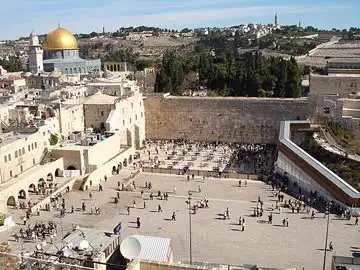
The Western Wall is an ancient stone wall in the Old City of Jerusalem. In Hebrew it is called HaKotel HaMa'aravi, often shortened to the Kotel. English speakers have also called it the Wailing Wall, and in Arabic it is known as the Buraq Wall. It is part of a huge retaining wall, a wall that holds back earth, built about 2,000 years ago around a hill called the Temple Mount.
See it on the 3D globe →At a glance
- Country
- Palestinian Territories
- Location
- Old City of Jerusalem
- Built
- -19
- Height
- 19 m
- Type
- Religious building
Quick answers
Where is Western Wall?
Western Wall is in Old City of Jerusalem, Palestinian Territories.
When was Western Wall built?
Western Wall was built in 19 BC.
How tall is Western Wall?
Western Wall is about 19 m tall.
A remnant of Herod’s retaining wall around the Temple Mount and the holiest place of prayer in Judaism.
For Jewish people it is the holiest place where they are allowed to pray, because it stands closest to where the most sacred part of their ancient Temple, the Holy of Holies, is believed to have been. People of many faiths visit it, and a large open plaza in front of the wall is set aside for prayer.
History
Around 19 BCE, King Herod began a huge project to rebuild the Second Temple in Jerusalem and make the hill it stood on much bigger. Builders created a flat platform by putting four massive walls around the hill and filling the space inside; the Western Wall is one of them. In 70 CE the Romans destroyed the Temple, but this wall survived. Over the centuries Jews came here to pray and to mourn the lost Temple. The name Wailing Wall came from 19th-century European visitors who saw people weeping as they prayed.
How it was built
The lowest rows of stones are the oldest. Herod's builders cut enormous blocks of local limestone so precisely that they were stacked without any mortar (the cement-like paste usually used between stones). Most blocks weigh between about 2 and 7 tonnes, but one giant stone hidden underground is over 13 metres long and weighs roughly 250 to 300 tonnes. Medium-sized stones were added on top in later centuries, and the small stones at the very top come mainly from the Ottoman period, about 500 years ago.
Visiting today
The whole western wall of the Temple Mount is about 488 metres long, but only about 57 metres face the prayer plaza; most of the rest is hidden behind later buildings. At the plaza the wall rises about 19 metres above the ground, and it continues another 13 metres or so below. Visitors often write prayers or wishes on small pieces of paper and tuck them into the cracks between the stones. More than a million notes are left each year, and they are collected and respectfully buried twice a year.
Fun facts
- People tuck written prayers on paper into the cracks between its stones.
- Its biggest known stone, hidden underground, is longer than a city bus and weighs as much as about 50 elephants.
- Herod's builders fitted the giant blocks together without any mortar.
- More than a million handwritten notes are tucked into the wall's cracks every year.
- You can read the wall's history in its stones: the huge ones at the bottom are about 2,000 years old, and the small ones at the top are much newer.
On the globe
The model shows a long stretch of the ancient stone wall in Jerusalem's Old City. Zoom in to look at its rows of large stone blocks.
Quiz time
Which is taller: Western Wall or Dome of the Rock?
Show the answer
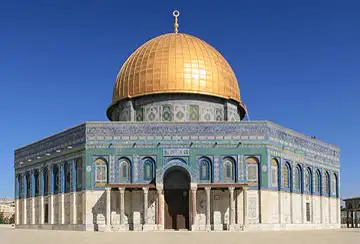
Dome of the Rock. (19 m vs 35 m) Dome of the Rock →
Nearby on the globe

Sources
- Read more on Wikipedia
- Western Wall — Wikipedia
- 통곡의 벽 — 위키백과
- Who Built the Western Wall and Why? — The Western Wall Heritage Foundation
Updated: 2026-10-13