
Mount Fuji
후지산
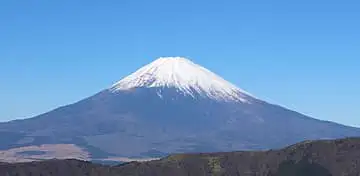
Mount Fuji is the tallest mountain in Japan, rising 3,776 metres above sea level on the main island of Honshu. It sits on the border of Shizuoka and Yamanashi prefectures, about 100 km southwest of Tokyo, and on clear days people in the city can see its snowy cone on the horizon.
See it on the 3D globe →At a glance
- Country
- Japan
- Location
- Shizuoka & Yamanashi, Japan
- Height
- 3,776 m
- Type
- Volcano
Quick answers
Where is Mount Fuji?
Mount Fuji is in Shizuoka & Yamanashi, Japan.
Japan's highest peak, a near-symmetrical active volcano long revered in art and religion.
Fuji is an active stratovolcano, which means a steep cone built up from many layers of lava and ash. Its almost perfectly balanced shape has made it a national symbol. For centuries people have climbed it as a sacred pilgrimage, and painters and poets have used it again and again in their work. In 2013 UNESCO added it to the World Heritage List as "Fujisan, sacred place and source of artistic inspiration."
How the volcano formed
The rocks of Mount Fuji go back about 100,000 years, but the smooth cone we see today, sometimes called "New Fuji", formed only in the last 10,000 years or so, as fresh eruptions covered older volcanoes underneath. Fuji has not erupted since the Hōei eruption, which began on 16 December 1707 and lasted until about the start of 1708. Scientists still count it as active, so it is watched closely. Five lakes curve around its northern foot: Kawaguchi, Yamanaka, Sai, Motosu and Shōji, and they are famous spots for seeing the mountain reflected in the water.
A sacred mountain and a muse for artists
In Japan's Shinto religion, Fuji is linked to the goddess Konohanasakuya-hime, and the Fujisan Hongū Sengen Taisha shrine is dedicated to her. Pilgrims have walked to the summit for hundreds of years; the loop path around the summit crater, called Ohachi-meguri, follows an old pilgrimage route. Artists have loved the mountain too. In the 1830s the woodblock artist Hokusai made the series Thirty-six Views of Mount Fuji, showing the peak behind waves, farms and city streets. Those prints helped make Fuji one of the best-known mountains on Earth.
Climbing Mount Fuji today
There are four main trails to the top: Yoshida, Subashiri, Gotemba and Fujinomiya. The official climbing season is short, from early July to early September, because snow covers the peak for about five months of the year and huts and first-aid stations close outside the season. The Yoshida trail is often suggested for beginners because it has many mountain huts. Many climbers rest in a hut partway up, then hike through the night to watch the sunrise above the clouds from the summit.
Fun facts
- Its last eruption was the Hōei eruption of 1707.
- On clear days, Mount Fuji can be seen from Tokyo, about 100 km away.
- Fuji's last eruption started in December 1707 and is called the Hōei eruption.
- Snow usually starts to cap the summit in early October and stays for about five months a year.
- Hokusai's famous print series about the mountain is called Thirty-six Views of Mount Fuji.
- A walk around the summit crater follows a path that pilgrims have used for centuries.
On the globe
The model shows Japan's highest peak as a near-symmetrical volcanic cone. Look for its gentle, even slopes rising to a single summit, the shape that made Fuji famous in art.
Nearby on the globe


Sources
- Read more on Wikipedia
- Mount Fuji — Wikipedia
- Mt. Fuji hiking course — Japan National Tourism Organization (japan.travel)
- Official Web Site for Mt. Fuji Climbing
Updated: 2026-10-13