
Niagara Falls
나이아가라 폭포
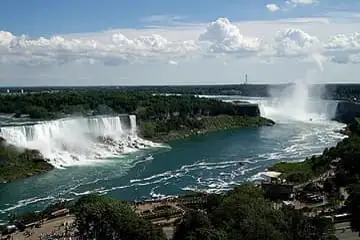
Niagara Falls is a group of three waterfalls on the Niagara River, right on the border between the Canadian province of Ontario and the US state of New York. The largest, Horseshoe Falls, is a curved wall of water shared by both countries. The two smaller ones, American Falls and Bridal Veil Falls, are in the United States and are separated by little islands.
See it on the 3D globe →At a glance
- Country
- Canada
- Location
- Canada–USA border
- Height
- 57 m
- Type
- Waterfall
Quick answers
Where is Niagara Falls?
Niagara Falls is in Canada–USA border.
How tall is Niagara Falls?
Niagara Falls is about 57 m tall.
Three waterfalls straddling the Canada–US border, famous for their enormous volume of water.
The Niagara River carries water from Lake Erie to Lake Ontario, and on the way it pours over a cliff. Niagara is not especially tall: hundreds of waterfalls around the world are higher. What makes it special is the enormous amount of water. In busy daytime hours more than 168,000 cubic metres of water go over the edge every minute, the biggest flow of any waterfall in North America. More than 20 million visitors come every year.
How it formed
During the last ice age, thick ice sheets covered this region. When the ice melted, the Great Lakes filled up and their water found a path over a long cliff called the Niagara Escarpment. The top of the cliff is hard limestone and dolomite, but softer shale lies underneath. The rushing water wears away the soft layer, the hard rock above loses its support, and big chunks break off. Bit by bit, the falls have crept upstream by about 11 kilometres over roughly 12,500 years, carving the deep Niagara Gorge behind them.
How big is it?
Horseshoe Falls drops about 57 metres into the river below, and its curved edge, or crest, is roughly 670 metres long. The American Falls lands on a pile of fallen boulders, so its visible drop is only about 21 to 34 metres. The water below Horseshoe Falls is around 35 metres deep. Much of the river is sent through tunnels to power stations that make electricity, so a 1950 treaty between Canada and the US sets how much must still flow over the falls: more during summer days for visitors, and about half as much at night.
Daredevils and visitors
Niagara has attracted thrill-seekers for a long time. In 1859 a tightrope walker known as Blondin crossed the gorge on a rope, and once even carried his manager on his back. In 1901 a 63-year-old teacher, Annie Edson Taylor, became the first person to go over the falls in a barrel and survive. Stunts like this are now against the law on both sides of the border. Most visitors simply ride the tour boats, which have carried passengers into the spray below the falls since 1846.
Fun facts
- It is made up of three falls: Horseshoe, American and Bridal Veil.
- Before Annie Edson Taylor's barrel ride in 1901, her cat was sent over the falls in the same barrel as a test, and it survived.
- In 1969 engineers built a temporary dam and switched off the American Falls for several months so they could study and strengthen the rock.
- The falls are still wearing back by about 30 centimetres a year, much slower than in the past.
- The water's green colour comes from about 60 tonnes of dissolved minerals and finely ground rock that the river carries over the edge every minute.
- Around 100,000 gulls spend the winter along the Niagara River, because its fast water rarely freezes.
On the globe
The model shows the three waterfalls sitting on the Canada–US border, with a huge amount of water pouring over the edge. Zoom in to find the wide curve of Horseshoe Falls and the smaller falls beside it.
Quiz time
Which is taller: Niagara Falls or CN Tower?
Show the answer
CN Tower. (57 m vs 553 m) CN Tower →
Nearby on the globe







Sources
- Read more on Wikipedia
- Niagara Falls — Wikipedia
- 나이아가라 폭포 — 위키백과
- Niagara Falls Geology Facts & Figures — Niagara Parks
Updated: 2026-10-13