
Nyhavn
뉘하운
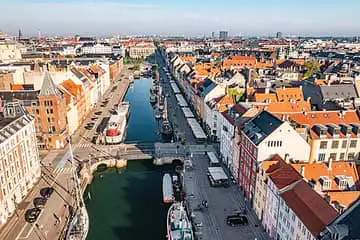
Nyhavn, which means New Harbour in Danish, is a canal and waterfront in the centre of Copenhagen, the capital of Denmark. It runs from the city square Kongens Nytorv out to the city's harbour. Its sunny north side is lined with tall, narrow townhouses painted in bright colours, and old wooden sailing ships float along the canal.
See it on the 3D globe →At a glance
- Country
- Denmark
- Location
- Copenhagen, Denmark
- Built
- 1673
- Type
- Historic district
Quick answers
Where is Nyhavn?
Nyhavn is in Copenhagen, Denmark.
When was Nyhavn built?
Nyhavn was built in 1673.
A 17th-century canal harbour lined with brightly coloured townhouses and wooden ships.
King Christian V had the canal dug in the early 1670s to give ships a way from the sea right into the old city, where they could unload goods and fish. For a long time it was a rough sailors' quarter full of taverns. Today it is one of Copenhagen's best-known sights, a lively place where locals and visitors sit at outdoor cafés by the water and board boats for canal tours. The famous fairy-tale writer Hans Christian Andersen once lived here.
History
The canal was dug between about 1670 and 1673, partly by Swedish prisoners of war captured in a war between Denmark and Sweden. As ocean-going ships grew bigger, Nyhavn became a harbour for small Danish cargo boats instead. After World War II, trucks and trains took over that work, and the canal was left almost empty of ships. In the 1960s a local society began working to bring the area back to life. In 1977 Nyhavn became a harbour for historic ships, and in 1980 the quay, which had been used as a car park, was turned into a pedestrian street.
The colourful houses
The houses on the north side were built from wood, brick and plaster in the 17th and early 18th centuries. The oldest one, at number 9, dates from 1681. Hans Christian Andersen lived in three different houses here, at numbers 20, 67 and 18, and wrote some of his fairy tales while living on the canal, including The Tinderbox and The Princess and the Pea. A plaque now marks number 67, where he lived from 1845 to 1864. The south side has grander mansions, including Charlottenborg Palace at the corner of the square.
Old ships and the Memorial Anchor
The inner part of the canal is a museum harbour for veteran ships. The south side holds ships owned by Denmark's National Museum, such as a lightship from 1895 that once worked as a floating lighthouse, while the north side has privately owned wooden ships that can still sail. At the end of the canal stands a large anchor from 1872. It honours more than 1,700 Danish sailors who died in World War II, and a ceremony is held there every 5 May, the day Denmark was freed in 1945.
Fun facts
- Writer Hans Christian Andersen lived in houses on Nyhavn.
- One of the old boats in Nyhavn was built in 1920 as a smuggling ship and was later caught by customs officers.
- Another old barge in the canal has been used as a floating theatre since 1972.
- A footbridge near Nyhavn is nicknamed the Kissing Bridge because its two halves meet in the middle like two tongues.
- Nyhavn hosts a Christmas market each December, with stalls and twinkling lights along the canal.
On the globe
The model shows Copenhagen's 17th-century canal harbour lined with brightly coloured townhouses and wooden ships. Zoom in to see the row of coloured house fronts beside the water.
Quiz time
Which is older: Nyhavn or Berlin TV Tower (Fernsehturm)?
Show the answer
Nyhavn. (1673 vs 1969) Berlin TV Tower (Fernsehturm) →
Nearby on the globe





Sources
Updated: 2026-10-13