
Palace of Knossos
크노소스 궁전
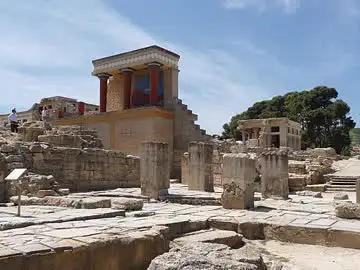
Knossos is an archaeological site on the island of Crete, Greece, about 5 kilometres south of the city of Heraklion. It was the biggest and best-known centre of the Minoan civilisation, which is widely regarded as Europe's earliest advanced civilisation. People lived on its hill from about 7000 BC, so Knossos is often called Europe's oldest city.
See it on the 3D globe →At a glance
- Country
- Greece
- Location
- Crete, Greece
- Built
- -1900
- Type
- Ancient site
Quick answers
Where is Palace of Knossos?
Palace of Knossos is in Crete, Greece.
When was Palace of Knossos built?
Palace of Knossos was built in 1900 BC.
The great palace of Minoan Crete, known for its downward-tapering red columns and bull frescoes.
The site is dominated by the huge Palace of Minos, first built around 1900 BC and rebuilt on a grander scale after an earthquake-like destruction around 1700 BC. Most scholars see it as a centre for government, trade, religion and ceremony. Greek myths linked it to King Minos, the Minotaur and the Labyrinth. In 2025 it was listed by UNESCO as part of the Minoan Palatial Centres.
The Minoan palace
At its height, from about 1700 to 1450 BC, the palace had a great central court, grand staircases, storerooms, reception rooms, light wells, drains and richly painted walls. Pottery, frescoes and records show that Knossos traded and swapped ideas across Crete and the eastern Mediterranean. After about 1450 BC it came under Mycenaean Greek influence, and clay tablets in an early form of Greek, called Linear B, record its stores of goods and animals.
The Labyrinth legend
In the Greek myths, King Minos had Daedalus build the Labyrinth to hold the Minotaur, a creature with a man's body and a bull's head. The hero Theseus beat it with help from Ariadne's thread. Nobody knows whether the palace inspired the story, but its twisting plan of courts, corridors and stairs may have helped create the Labyrinth idea. Ancient coins from Knossos even showed a labyrinth pattern.
Digging up Knossos
The first known modern dig was in 1878 and 1879, led by the Cretan merchant Minos Kalokairinos, who uncovered storerooms with giant jars called pithoi. A long, careful survey around the site has since shown that people lived in the area from about 7000 BC all the way into modern times, and that Knossos stayed important through the Greek, Roman and early Byzantine periods.
Fun facts
- Legend links it to King Minos and the Labyrinth of the Minotaur.
- People settled the hill around 7000 BC.
- Linear B tablets from Knossos record an early form of Greek.
- Ancient Knossos coins show a labyrinth.
- The scholar's word 'labyrinth' may come from 'labrys', a double axe, but this idea is still debated.
On the globe
The model shows the palace with its red columns that get narrower toward the bottom.
Quiz time
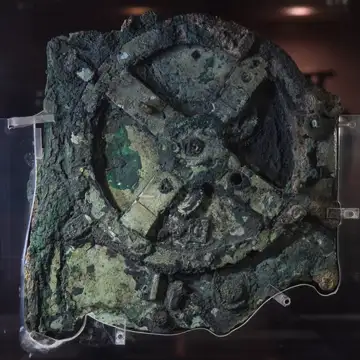
Which is older: Palace of Knossos or Antikythera wreck?
Show the answer
Palace of Knossos. (1900 BC vs 65 BC) Antikythera wreck →
Nearby on the globe

Sources
- Read more on Wikipedia
- Knossos — Wikipedia (English)
- 크노소스 — 위키백과 (한국어)
- Knossos — Wikipedia (full article)
Updated: 2026-10-14