
Prophet's Mosque (Al-Masjid an-Nabawi)
예언자의 모스크(알마스지드 안나바위)
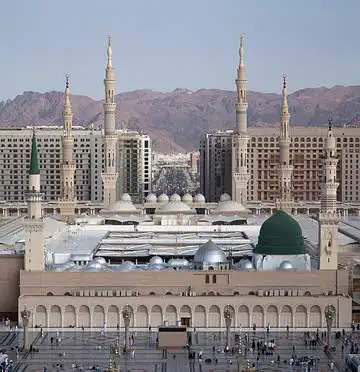
The Prophet's Mosque, called Al-Masjid an-Nabawi in Arabic, stands in the heart of Medina in Saudi Arabia. The Prophet Muhammad built the first mosque here in 622, soon after he arrived in Medina, and he helped with the work himself. It is the second holiest site in Islam, after the Great Mosque in Mecca, and it is a major place of pilgrimage for Muslims from all over the world.
See it on the 3D globe →At a glance
- Country
- Saudi Arabia
- Location
- Medina, Saudi Arabia
- Built
- 622
- Height
- 104 m
- Type
- Religious building
Quick answers
Where is Prophet's Mosque (Al-Masjid an-Nabawi)?
Prophet's Mosque (Al-Masjid an-Nabawi) is in Medina, Saudi Arabia.
When was Prophet's Mosque (Al-Masjid an-Nabawi) built?
Prophet's Mosque (Al-Masjid an-Nabawi) was built in 622.
How tall is Prophet's Mosque (Al-Masjid an-Nabawi)?
Prophet's Mosque (Al-Masjid an-Nabawi) is about 104 m tall.
The mosque founded by the Prophet Muhammad, whose tomb lies beneath the Green Dome; giant parasols shade its plazas.
Under the famous Green Dome, in the south-east corner, lies the resting place of the Prophet Muhammad, together with the first two caliphs (leaders of the early Muslim community), Abu Bakr and Umar. Over almost 1,400 years, rulers have rebuilt and enlarged the mosque again and again. Today it is one of the largest mosques in the world, with ten tall minarets and courtyards shaded by giant umbrellas that open and close.
History
The first mosque was small and simple: an open courtyard about 30 by 36 metres, with a roof of palm trunks, clay and palm leaves only about 3.6 metres high. It took seven months to build. Besides being a place of prayer, it was a community centre, a court and a school. Later rulers expanded it many times, and the Umayyad caliph al-Walid I brought the Prophet's tomb inside its walls. In 1909 it became the first place in the Arabian Peninsula to get electric lights.
The Green Dome and the minarets
A dome was first built over the Prophet's tomb in 1279, made of wood, and later rebuilt in stone. It was painted green in 1837 and has been called the Green Dome ever since. The four corner towers added in al-Walid's time may have been among the very first minarets, the tall towers from which the call to prayer is given. A huge expansion between about 1985 and 1994 added six new minarets about 104 metres tall, bringing the total to ten.
Keeping cool in the desert
Medina can be extremely hot, so the mosque has clever ways to shade worshippers. Its flat roof has 27 domes that slide along metal tracks: they can cover the prayer hall or roll aside to let in light and air. Outside, 250 giant electric umbrellas stand in the courtyards. They fold up like flowers when they are not needed and open to shade about 143,000 square metres of ground, about the area of 20 football pitches.
Fun facts
- Giant umbrellas in its courtyard open to shade worshippers from the sun.
- The first mosque on this site had a roof made of palm trunks and palm leaves.
- The 250 giant umbrellas in the courtyards open and close automatically with the weather.
- Twenty-seven domes on the roof can slide open and shut on metal tracks.
- The Green Dome has been green only since 1837.
On the globe
The model shows the great mosque in Medina with its Green Dome, tall minarets and wide plazas shaded by giant parasols. Zoom in to find the green dome among the minarets.
Quiz time
Which is taller: Prophet's Mosque (Al-Masjid an-Nabawi) or Maraya Concert Hall?
Show the answer
Prophet's Mosque (Al-Masjid an-Nabawi). (104 m vs 26 m) Maraya Concert Hall →
Nearby on the globe

Sources
- Read more on Wikipedia
- Prophet's Mosque — Wikipedia
- 예언자의 모스크 — 위키백과
- What is the Length of the Minarets of the Prophet's Mosque? — Saudipedia
Updated: 2026-10-13