
Hegra (AlUla)
헤그라 (알울라)
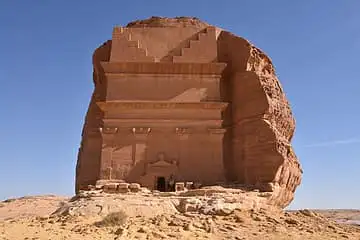
Hegra, also called Mada'in Salih, is an ancient city in AlUla, in northwestern Saudi Arabia. It was the southernmost and second-largest city of the Nabataean kingdom after Petra, the famous rose-red city in Jordan. Its biggest sights are more than 110 well-preserved tombs cut into sandstone rocks that stand alone in the desert.
See it on the 3D globe →At a glance
- Country
- Saudi Arabia
- Location
- AlUla, Saudi Arabia
- Built
- 1st c. AD
- Type
- Ancient site
Quick answers
Where is Hegra (AlUla)?
Hegra (AlUla) is in AlUla, Saudi Arabia.
Over 100 monumental Nabataean tombs carved into sandstone outcrops across the desert.
UNESCO listed Hegra in 2008, and it was the first World Heritage Site in Saudi Arabia. Most remains date from the 1st century BC and 1st century AD. Among Saudi Arabia's 4,000 archaeological sites it has been nicknamed "The Capital of Monuments".
The Nabataeans
The Nabataeans were desert traders who grew rich from caravans carrying incense and myrrh. Hegra lay on a major north-south caravan route, at a crossroads of trade, and it connected to a Red Sea port.
Rome annexed their kingdom in 106 AD, and more than 30 Nabataean, Greek and Latin inscriptions from the period were found. Traces of earlier Lihyanite people, and of Roman times, can also be seen.
Tombs with legal writing
The site has 131 monumental tombs counted in four burial areas, some over 20 metres high. The largest, Qasr al-Farid, stands alone. Their carved fronts mix local and foreign styles, showing how many cultures met here.
Writing above many doors names the owner and the burial rights, and it acted as a legal document.
An oasis in a very dry land
The climate is extremely dry, with less than 50 millimetres of rain a year. Even so, the city sat where runoff from the rocks collects, and the groundwater was close to the surface. The Nabataeans dug many deep wells to water their farms and travellers.
The dry air and the fact that nobody resettled the place later kept it in extraordinary condition. In the Quran this area was home to the Thamudi people, so many locals saw it as a cursed place, and it was left alone. The name Mada'in Salih means "cities of Salih".
Fun facts
- In 2008 it became Saudi Arabia's first UNESCO World Heritage Site.
- It was Saudi Arabia's first UNESCO World Heritage Site.
- Tombs have legal writing above the doors.
- Qasr al-Farid is the largest tomb and stands alone.
- The site gets less than 50 millimetres of rain in an average year.
On the globe
The model shows tomb fronts carved into sandstone outcrops in the desert. Look for the carved entrances.
Nearby on the globe
,_the_kingdom%27s_second_Nabatean_capital_after_Petra,_Saudi_Arabia.jpg)
Sources
Updated: 2026-10-14