
Torres del Paine
토레스 델 파이네
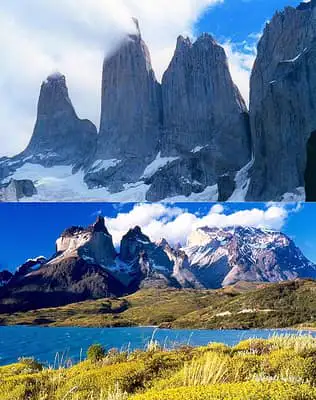
Torres del Paine National Park is a wild mountain park in Patagonia, at the southern tip of Chile in South America. It protects jagged granite peaks, glaciers, turquoise lakes, rivers and windy grasslands. Its name means "Towers of Paine": the towers are three tall granite spires, and Paine is said to be the word for "blue" in the language of the Tehuelche (Aonikenk), the native people of the region.
See it on the 3D globe →At a glance
- Country
- Chile
- Location
- Patagonia, Chile
- Height
- 2,500 m
- Type
- Park
Quick answers
Where is Torres del Paine?
Torres del Paine is in Patagonia, Chile.
A Patagonian park of jagged granite spires, glaciers and turquoise lakes.
The park sits about 112 kilometres north of the town of Puerto Natales and covers roughly 1,800 square kilometres. It was created in 1959 and named a UNESCO Biosphere Reserve in 1978, a special status for places where nature and people are studied together. It is one of the largest and most visited parks in Chile, welcoming about 252,000 visitors a year.
Towers, horns and glaciers
The heart of the park is the Paine Massif, a group of mountains rising sharply from the flat steppe. The three Torres del Paine stand about 2,500 metres above sea level, and next to them are the Cuernos del Paine, or "Horns of Paine", more sharp peaks joined to the towers. The highest summit in the massif is Paine Grande, at about 2,884 metres. To the west, Grey Glacier and other glaciers flow from the Southern Patagonian Ice Field.
Why the lakes are so blue
Lakes such as Grey, Pehoé, Nordenskjöld and Sarmiento shine in bright blue and turquoise. The colour comes from "rock flour", extremely fine dust made when glaciers grind against the rock beneath them. Meltwater carries the dust into the lakes, where it floats and reflects sunlight in blue-green shades. The park is also famous for its strong winds, which are strongest from November to January, the busiest time for visitors.
Animals of the park
Guanacos, wild relatives of llamas and alpacas, graze in herds on the grasslands. Pumas, also called cougars, are the park's top predators, and scientists have studied how they hunt guanacos here. The park is also home to foxes and to the huemul, an endangered South Andean deer. Overhead you might see Andean condors, giant vultures of the Andes. Sadly, fires started by careless visitors in 1985, 2005 and 2011 each burned more than 150 square kilometres of the park.
Fun facts
- 'Paine' is an old Tehuelche word for blue.
- Paine is said to mean "blue" in the Tehuelche language.
- The park's first name, in 1959, was Grey Lake National Tourism Park; it got its present name in 1970.
- The lakes get their turquoise colour from rock dust ground up by glaciers.
- An early British visitor, Lady Florence Dixie, called the three towers "Cleopatra's Needles" in 1880.
On the globe
The model shows Patagonia's jagged granite spires rising above glaciers and turquoise lakes in southern Chile. Zoom in to pick out the three towers among the peaks.
Nearby on the globe


Sources
- Read more on Wikipedia
- Torres del Paine National Park — Wikipedia
- 토레스델파이네 국립공원 — 위키백과
- Torres del Paine National Park — WorldAtlas
Updated: 2026-10-13