
Walled City of Cartagena
카르타헤나 구시가지
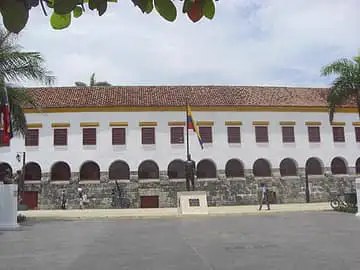
The Walled City of Cartagena is the old heart of Cartagena de Indias, a port city on the Caribbean coast of Colombia. Inside its thick stone walls are narrow streets, colourful houses with wooden balconies, quiet squares, churches and old mansions from the time when Spain ruled the region.
See it on the 3D globe →At a glance
- Country
- Colombia
- Location
- Cartagena, Colombia
- Built
- 16th c.
- Type
- Historic district
Quick answers
Where is Walled City of Cartagena?
Walled City of Cartagena is in Cartagena, Colombia.
A walled colonial port on the Caribbean, known for colourful streets, balconies and stout fortifications.
The Spanish commander Pedro de Heredia founded the city on 1 June 1533, on the site of an Indigenous village. Its sheltered bay made it one of the most important ports in Spain's American empire: ships gathered here before carrying gold and other goods back to Europe. That wealth attracted pirates and enemy fleets, so the Spanish surrounded the city with about 11 kilometres of walls and built strong forts around the bay. In 1984 the port, fortresses and old monuments of Cartagena were listed together as a UNESCO World Heritage Site.
Why the walls were built
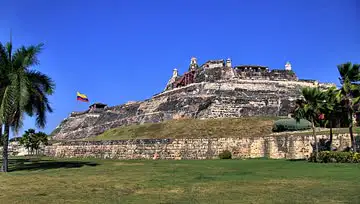
Rich ports were tempting targets. In 1586 the English sailor Francis Drake attacked Cartagena with 23 ships, burned around 200 houses and only left after the city paid a ransom. A French raid in 1697 carried off a huge treasure. To stop such attacks, the Spanish built the city walls in stages between 1614 and 1796. The great fortress of San Felipe de Barajas, finished in 1654 and later enlarged, guards the land side of the city and is full of tunnels.
History
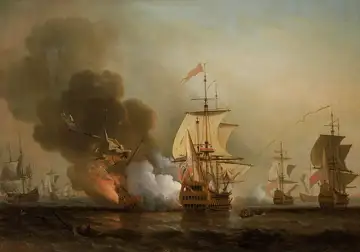
In 1741 a very large British fleet led by Admiral Edward Vernon tried to capture Cartagena. A much smaller Spanish force under Blas de Lezo held out, and the British finally sailed away. The city also has a darker past: it was one of the main ports where enslaved Africans were brought and sold in the Americas. In 1811 Cartagena declared its independence from Spain, and soon after it survived a long siege by Spanish troops in 1815 and 1816. Today it is often nicknamed "the Heroic City".
Visiting today
The main gateway into the old city is the Clock Tower gate, a grand Baroque entrance built between 1704 and 1738. Behind it, the streets are lined with brightly painted houses, churches and old mansions, and the old Palace of the Inquisition, completed in 1770, still stands on one of the squares. Just outside the walls, the San Felipe de Barajas fortress sits on San Lázaro hill, where visitors can see how the city was once defended from attack by land.
Fun facts
- It was founded in 1533 by the Spanish commander Pedro de Heredia.
- The stone walls around the old city stretch for about 11 kilometres.
- Building all the walls took nearly two centuries, from 1614 to 1796.
- The San Felipe de Barajas fortress has underground tunnels built to help defend the city.
- Cartagena has several nicknames, including "the Heroic City" and "the Magic City".
On the globe
The model shows a walled colonial port on the Caribbean, with colourful streets, balconies and stout fortifications. Zoom in on Colombia's northern coast to find it.
Nearby on the globe


Sources
Updated: 2026-10-13