
African buffalo
아프리카물소
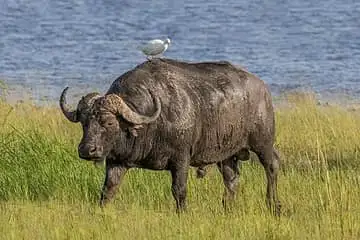
A bold wild cattle that roams in herds of hundreds and will gang up to fend off lions. It weighs around 600 kg, and the bases of its horns join across the forehead into a solid helmet-like shield.
See it on the 3D globe →At a glance
- Class
- Mammals
- Lives in
- Kafue National Park, Zambia
- Diet
- Plant eater (herbivore)
- Weight
- about 600 kg
- Length
- about 3 m
- Top speed
- about 56 km/h
- Conservation status
- Near Threatened (IUCN NT)
- Habitat
- savannas, grasslands, wetlands
Quick answers
Where does the African buffalo live?
It lives in savannas, grasslands, wetlands. On the globe you can find it near Kafue National Park, Zambia.
How big is the African buffalo?
It grows to about 3 m and 600 kg.
What does the African buffalo eat?
Its diet: plant eater (herbivore).
How fast is the African buffalo?
It can reach about 56 km/h.
Is the African buffalo endangered?
It is listed as Near Threatened (IUCN NT).
The African buffalo is a large wild bovid that lives across sub-Saharan Africa, in woodlands, savannas, forests, grasslands and wetlands. It has a heavy body, a broad head, a strong neck and large horns. In males the horn bases fuse into a bony shield on the forehead called a boss.
It lives in herds from a few animals up to more than a thousand, and it is bold enough that herds will gather to fend off lions. As of 2019 the IUCN lists it as Near Threatened. The tail ends in a dark, hairy tuft, and the fur ranges from rusty to black.
What does it eat?
The African buffalo is a grazer. It is a ruminant, which means it chews cud, and it feeds mostly on grass and other fibre. A herd typically consists of adult females with their young, plus some adult males that join for a while to mate. Males have a pecking order, and the strongest get the best mates. The species lives in woodlands, savannas, forests, grasslands, shrublands and wetlands, so it can be found in many different kinds of country.
Calves and danger
After about 340 days, a female gives birth to a single calf. Weaning takes 10 to 18 months. Adults are so big and strong they have few natural predators, but calves are far more vulnerable. Poaching, farming, disease and climate change have shrunk the buffalo's range since the 19th century. Weaning is done after 10 to 18 months, and a buffalo lives about 12 years in the wild. Efforts in protected parks have helped numbers grow in some areas.
Fun facts
- In males, the bases of the horns fuse into a solid shield across the forehead called a boss.
- Four subspecies are recognised, including the Cape buffalo.
- Its fur ranges from rusty to black.
- About 398,000 to 401,000 mature adults were estimated in 2019.
On the globe
The model shows a dark buffalo with a helmet-like horn boss. Look for it on the African savanna.
Quiz time
Which is heavier: African buffalo or Blue wildebeest?
Show the answer
African buffalo. (600 kg vs 200 kg) Blue wildebeest →
More like this
_male_with_cattle_egret.jpg)
Sources
Updated: 2026-10-14