
Blue wildebeest
검은꼬리누
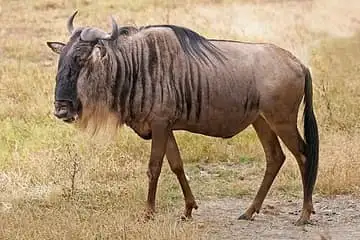
The blue wildebeest is a cow-like antelope whose herds, numbering hundreds of thousands, migrate each year in search of fresh grass and water. A calf can stand and walk within minutes of birth and soon outrun lions.
See it on the 3D globe →At a glance
- Class
- Mammals
- Lives in
- Liuwa Plain, Zambia
- Diet
- Plant eater (herbivore)
- Weight
- about 200 kg
- Length
- about 2.7 m
- Top speed
- about 80 km/h
- Lifespan
- up to about 20 years
- Conservation status
- Least Concern (IUCN LC)
- Habitat
- savannas, grasslands
Quick answers
Where does the Blue wildebeest live?
It lives in savannas, grasslands. On the globe you can find it near Liuwa Plain, Zambia.
How big is the Blue wildebeest?
It grows to about 2.7 m and 200 kg.
What does the Blue wildebeest eat?
Its diet: plant eater (herbivore).
How fast is the Blue wildebeest?
It can reach about 80 km/h.
How long does the Blue wildebeest live?
It can live up to about 20 years.
Is the Blue wildebeest endangered?
It is listed as Least Concern (IUCN LC).
The blue wildebeest, or common wildebeest, is a large antelope of southern and eastern Africa. It has a muscular, front-heavy body, a broad muzzle and curved horns on both males and females. Adults range from slate-blue to light grey or grey-brown.
It lives on short-grass plains next to acacia savanna, in places that are neither too wet nor too dry. About 1.5 million are estimated, and it is rated Least Concern. It is also known as the white-bearded gnu or brindled gnu. It is also known for being fast and extremely cautious, and herds often mix with zebras on the plains.
The great migration
Three African populations make long migrations timed with the rains and the grass growth, looking for rich short grass to feed mothers and growing calves.
The best-known migration is in the Serengeti and Maasai Mara, where herds of well over a million animals travel each year. The card's location is Liuwa Plain in Zambia, another place where herds gather. It is native to Angola, Botswana, Eswatini, Kenya, Mozambique, South Africa, Tanzania, Zambia and Zimbabwe.
Calves
Mating starts at the end of the rainy season, and a single calf is born after about 8.5 months. Calves are tawny brown and start to take adult colours at about two months old.
A calf stays with its mother for about eight months, then joins a group of young animals. Adults are extremely wary and fast runners, moving about in loose herds.
Fun facts
- In the Great Migration, over a million wildebeest travel between Tanzania's Serengeti and Kenya's Maasai Mara.
- Both males and females have horns.
- Calves can stand within minutes of birth, according to our card.
- Over a million wildebeest join the Great Migration.
On the globe
The model shows a herd of blue wildebeest on the Liuwa Plain.
Quiz time
Which is heavier: Blue wildebeest or African buffalo?
Show the answer
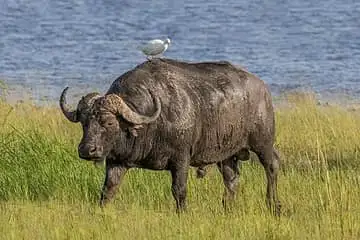
African buffalo. (200 kg vs 600 kg) African buffalo →
More like this

Sources
Updated: 2026-10-14