
Leopard
표범
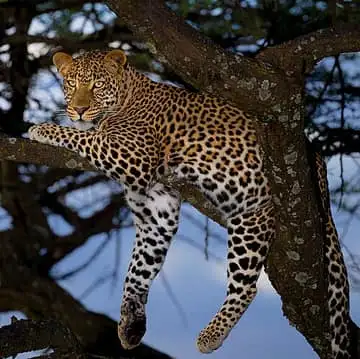
A powerful big cat that hauls prey heavier than itself up into trees to keep it from lions and hyenas. Its rosette-shaped spots hide it in the brush, and it can sprint at about 60 km/h.
See it on the 3D globe →At a glance
- Class
- Mammals
- Lives in
- South Luangwa, Zambia
- Diet
- Meat eater (carnivore)
- Weight
- about 54 kg
- Length
- about 2.1 m
- Top speed
- about 58 km/h
- Lifespan
- up to about 23 years
- Conservation status
- Vulnerable (IUCN VU)
- Habitat
- savannas, forests, mountains, rainforests
Quick answers
Where does the Leopard live?
It lives in savannas, forests, mountains, rainforests. On the globe you can find it near South Luangwa, Zambia.
How big is the Leopard?
It grows to about 2.1 m and 54 kg.
What does the Leopard eat?
Its diet: meat eater (carnivore).
How fast is the Leopard?
It can reach about 58 km/h.
How long does the Leopard live?
It can live up to about 23 years.
Is the Leopard endangered?
It is listed as Vulnerable (IUCN VU).
The leopard (Panthera pardus) is a slender, muscular big cat with pale yellow to dark golden fur covered in dark spots grouped into rosettes. It is about 92 to 183 centimetres long, not counting a tail of 66 to 102 centimetres. Males weigh 31 to 72 kilograms and females 20 to 43 kilograms. The first scientific description was made in 1758.
It lives across Africa and Asia in many habitats, from rainforest to steppe, including dry and mountain areas. The IUCN lists it as vulnerable because of habitat loss and fragmentation, and its numbers are falling in large parts of its range.
A clever solo hunter
The leopard is an opportunistic predator that hunts mostly hoofed animals and primates. It uses its spotted coat for camouflage, stalking quietly and ambushing its prey.
Sometimes it drags a kill up into a tree to keep it safe. Apart from the mating season and while raising cubs, leopards live alone. A mother usually has a litter of two to four cubs once every 15 to 24 months.
Old cat, wide range
Leopards first evolved in Africa during the Early Pleistocene and later spread into Eurasia. They once lived in Europe but disappeared there around the end of the last ice age.
Today scientists recognise eight subspecies. The English word leopard comes from the Greek leopardos, which may combine the words for lion and spotted. Leopard skins are popular in fashion, which has been one more pressure on the species.
Fun facts
- Leopards often drag their kills up into trees, out of reach of lions and hyenas.
- A leopard's spots form rosette shapes.
- It often hauls its prey up a tree.
- Leopards once lived across Europe.
- Scientists recognise eight leopard subspecies today.
On the globe
The model shows a spotted leopard, a big cat that can climb trees.
Quiz time
Which is heavier: Leopard or African wild dog?
Show the answer
Leopard. (54 kg vs 27 kg) African wild dog →
More like this
.jpg)
Sources
Updated: 2026-10-14