
African elephant
아프리카코끼리
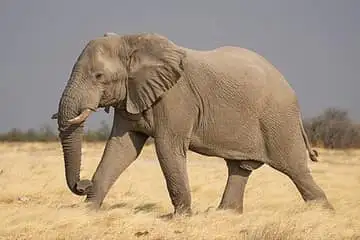
The African elephant is the largest land animal on Earth, with big males weighing close to 6 tonnes. It flaps its huge ears to shed heat, and its boneless trunk ends in two finger-like tips that can pick up small things.
See it on the 3D globe →At a glance
- Class
- Mammals
- Lives in
- Amboseli National Park, Kenya
- Diet
- Plant eater (herbivore)
- Weight
- about 4,500 kg
- Length
- about 7 m
- Top speed
- about 40 km/h
- Lifespan
- up to about 70 years
- Conservation status
- Endangered (IUCN EN)
- Habitat
- savannas, grasslands, forests
Quick answers
Where does the African elephant live?
It lives in savannas, grasslands, forests. On the globe you can find it near Amboseli National Park, Kenya.
How big is the African elephant?
It grows to about 7 m and 4,500 kg.
What does the African elephant eat?
Its diet: plant eater (herbivore).
How fast is the African elephant?
It can reach about 40 km/h.
How long does the African elephant live?
It can live up to about 70 years.
Is the African elephant endangered?
It is listed as Endangered (IUCN EN).
The African bush elephant, also called the savanna elephant, is the largest land animal on Earth. Fully grown males can stand about 3.2 metres tall at the shoulder and weigh around 6 tonnes. It lives across the savannas, grasslands and woodlands of sub-Saharan Africa. You can tell it from its Asian cousin by its huge ears, which some people say look a little like the shape of Africa.
Elephants are called 'ecosystem engineers' because they change the land around them. They dig waterholes in dry riverbeds that other animals drink from, spread seeds in their dung, and push over trees, which keeps grasslands open for zebras and antelopes. Since 2021 the African bush elephant has been listed as Endangered, mostly because of poaching for ivory and the loss of its habitat.
Amazing body
An elephant's trunk is its nose and upper lip joined together. It is used for breathing, smelling, drinking, trumpeting and grabbing food, and it contains about 40,000 muscles but no bones. The African elephant's trunk ends in two finger-like tips that can pick up small things. The giant ears are full of blood vessels and work like radiators, letting heat escape to keep the elephant cool. Both males and females can grow tusks, which are really long teeth that keep growing all their life.
What does it eat?
Elephants are herbivores, which means they eat only plants: grasses, leaves, roots, bark and fruit. An adult eats about 150 kilograms of food and drinks around 230 litres of water every day. Finding that much food takes a lot of walking, so elephants spend most of their day feeding and sleep only a little. In the dry season they use their tusks to dig for water and to strip bark from trees.
Family life
Elephant herds are led by a matriarch, usually the oldest and largest female. The herd is made of her daughters, sisters and their calves. Adult males, called bulls, usually live alone or in small bachelor groups. An elephant mother is pregnant for about 22 months, the longest of any mammal. A newborn calf already weighs around 90 kilograms (about 200 pounds) and stands nearly a metre tall. The whole family helps look after the young ones.
Fun facts
- An elephant's trunk has tens of thousands of muscles but no bones.
- An elephant is pregnant for about 22 months, longer than any other mammal.
- An elephant's trunk has about 40,000 muscles and not a single bone.
- African elephants have two 'fingers' at the tip of the trunk; Asian elephants have only one.
- Elephants cool off by spraying water on themselves, then cover their skin with dust like sunscreen.
- A newborn elephant calf weighs about as much as a grown man.
On the globe
The model shows an African elephant in Amboseli National Park, Kenya. Look for its big fan-shaped ears and long trunk.
Quiz time
Which is heavier: African elephant or Giraffe?
Show the answer
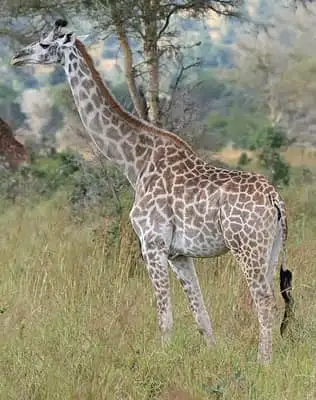
African elephant. (4,500 kg vs 1,000 kg) Giraffe →
More like this

Sources
- Read more on Wikipedia
- African bush elephant — Wikipedia
- African elephant, facts and photos — National Geographic
Updated: 2026-10-13