
Ethiopian wolf
에티오피아늑대
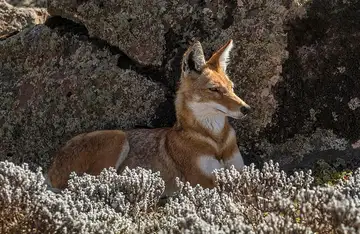
A rust-red wolf found only in the Ethiopian Highlands, one of Africa's rarest carnivores. It hunts mainly rodents such as giant mole-rats, and only around 500 survive in the wild.
See it on the 3D globe →At a glance
- Class
- Mammals
- Lives in
- Afroalpine grasslands above 3,000 m in Ethiopia
- Diet
- Meat eater (carnivore)
- Weight
- about 15 kg
- Conservation status
- Endangered (IUCN EN)
- Habitat
- mountains, grasslands
Quick answers
Where does the Ethiopian wolf live?
It lives in mountains, grasslands. On the globe you can find it near Afroalpine grasslands above 3,000 m in Ethiopia.
How big is the Ethiopian wolf?
It grows to about 15 kg.
What does the Ethiopian wolf eat?
Its diet: meat eater (carnivore).
Is the Ethiopian wolf endangered?
It is listed as Endangered (IUCN EN).
The Ethiopian wolf is a long-legged, red-and-white canine of the Ethiopian Highlands, including the Simien and Bale Mountains. It is also called the red jackal or Simien fox. It is similar in size and build to a coyote, with a long, narrow skull, an ochre to rusty-red coat, a white chest and underparts, and a thick tail with a black tip.
Unlike most big canids, which eat many kinds of food, the Ethiopian wolf is a specialist that hunts rodents of the high mountain meadows. It is one of the world's rarest canids and Africa's most endangered carnivore. It lives only in seven isolated mountain ranges at heights of 3,000 to 4,500 metres, and in 2011 the adult population was estimated at 360 to 440 animals, more than half of them in the Bale Mountains. The IUCN lists it as endangered.
Pack life, solo hunting
Ethiopian wolves live in family packs of up to 20 adults, although six is more usual. Only the dominant female breeds, and the others help guard and feed her pups. A pack holds a territory averaging 6 square kilometres. At night they rest together in the open, and at dawn, noon and evening they greet one another and patrol the borders, marking scent. Yet they usually hunt alone, by day, when rodents are active.
Hunting rodents
A wolf pounces on a rodent as it dashes between burrows, and if it misses it may dig furiously. Wolves in Bale have been seen walking among cattle herds, which may help hide them from rodents. They have also formed temporary partnerships with grazing geladas. Adults are about 84 to 101 cm long, stand 53 to 62 cm tall, and weigh 11 to 19 kg, with males about 20 percent heavier than females.
A fragile future
Pups are born between October and December in litters of two to six, tiny and toothless, with charcoal-grey fur. After the 1990s a rabies epidemic and shooting nearly wiped out some packs in Bale, and in 1994 the IUCN moved the wolf to critically endangered. Oxford University started the Ethiopian Wolf Conservation Programme in 1995, with vaccination of dogs and wolves and school programmes. Bale numbers recovered within a decade, and the species was downlisted to endangered in 2004.
Fun facts
- With fewer than 500 left, it is the world's rarest wild dog and Africa's most endangered carnivore.
- It is the rarest canid in the world and Africa's most endangered carnivore.
- It lives only on mountains between 3,000 and 4,500 metres.
- Charles Darwin guessed that it gave rise to greyhounds.
- Wolves in Bale have walked among cattle to ambush rodents.
On the globe
The model shows a slender, red and white wolf with a narrow muzzle, as in the card. Look at the red coat and white chest.
Quiz time
Which is heavier: Ethiopian wolf or Spotted hyena?
Show the answer
Spotted hyena. (15 kg vs 50 kg) Spotted hyena →
More like this
_2.jpg)
Sources
Updated: 2026-10-14