
American flamingo
아메리카홍학
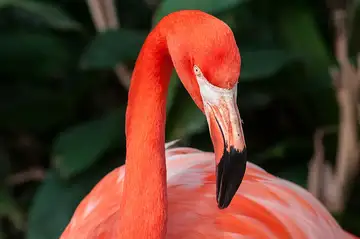
A flamingo of shallow lagoons and mudflats around the Caribbean and Galápagos. It has a very long neck and legs and a down-bent bill, and gets its deep pink-orange from pigments in its food. It lives in large flocks.
See it on the 3D globe →At a glance
- Class
- Birds
- Lives in
- Caribbean coasts, e.g. Inagua in the Bahamas
- Diet
- Filter feeder
- Weight
- about 2.5 kg
- Length
- about 1.3 m
- Lifespan
- up to about 40 years
- Conservation status
- Least Concern (IUCN LC)
- Habitat
- wetlands, coasts
Quick answers
Where does the American flamingo live?
It lives in wetlands, coasts. On the globe you can find it near Caribbean coasts, e.g. Inagua in the Bahamas.
How big is the American flamingo?
It grows to about 1.3 m and 2.5 kg.
What does the American flamingo eat?
Its diet: filter feeder.
How long does the American flamingo live?
It can live up to about 40 years.
Is the American flamingo endangered?
It is listed as Least Concern (IUCN LC).
The American flamingo is a large flamingo of the West Indies, northern South America, the Galápagos Islands and the Yucatán Peninsula. It is also called the Caribbean flamingo. It is the only flamingo that naturally lives in North America.
It has a very long neck and legs and a down-bent bill. Its deep pink-orange colour comes from pigments in its food. It lives in big flocks in saline lagoons, mudflats and shallow, brackish lakes along coasts and inland. It is closely related to the greater flamingo and the Chilean flamingo, and it is the species that Europeans first described from the Bahamas.
Where to find it
It breeds in the Galápagos Islands, coastal Colombia and Venezuela, northern Brazil, and on islands of the West Indies such as the Bahamas, Cuba, Jamaica and Hispaniola. On the Yucatán Peninsula it lives along the northern coast, for example in the Petenes mangroves. The Galápagos flamingos are genetically different and smaller, and some scientists treat them as a separate subspecies.
Hurricanes sometimes blow flocks far north, so lone flamingos have been seen as far as Kentucky, New York and Virginia.
A flamingo family
Scientists used to treat it as the same species as the greater flamingo of the Old World, but most experts now say they are separate. They are each other's closest relatives.
Linnaeus named it Phoenicopterus ruber in 1758, based partly on the English naturalist Mark Catesby's drawings of Bahamas flamingos. The species name means red in Latin. Two subspecies are recognised: one from the Caribbean to northeast Brazil and one in the Galápagos Islands.
The Florida mystery
Flamingos are a symbol of Florida, but for a long time people thought the birds seen there had escaped from zoos. In the 1800s, naturalists such as Audubon saw flocks of up to a thousand along southern Florida's coast, but heavy hunting wiped most out by about 1900. A study in 2018 confirmed that flamingos are native to Florida, and that some now live there all year. Part of their fame comes from a 1920s Miami Beach hotel named after the bird.
Fun facts
- It is the national bird of the Bahamas.
- Its colour comes from the food it eats.
- It was once counted as the same species as the greater flamingo.
- Hurricanes have blown flamingos as far north as New York.
On the globe
The model shows an American flamingo standing on its long legs. Look at the pink body and the down-bent bill.
Quiz time
Which is heavier: American flamingo or Bee hummingbird?
Show the answer
American flamingo. (2.5 kg vs 0.002 kg) Bee hummingbird →
More like this

Sources
Updated: 2026-10-14