
Andean cock-of-the-rock
안데스바위새
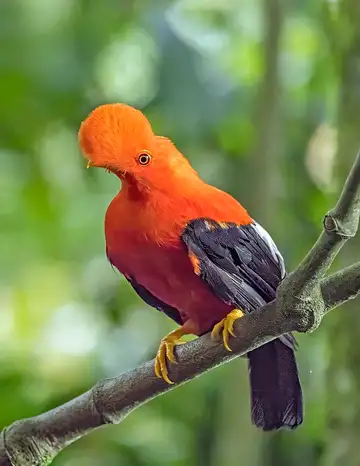
A bird of the Andean cloud forests with vivid orange plumage and a huge disc-shaped crest. Males gather at display grounds to dance for females. It is the national bird of Peru.
See it on the 3D globe →At a glance
- Class
- Birds
- Lives in
- Eastern Andean slopes (Colombia to Bolivia)
- Diet
- Eats both plants and meat (omnivore)
- Length
- about 0.32 m
- Conservation status
- Least Concern (IUCN LC)
- Habitat
- rainforests, mountains
Quick answers
Where does the Andean cock-of-the-rock live?
It lives in rainforests, mountains. On the globe you can find it near Eastern Andean slopes (Colombia to Bolivia).
How big is the Andean cock-of-the-rock?
It grows to about 0.32 m.
What does the Andean cock-of-the-rock eat?
Its diet: eats both plants and meat (omnivore).
Is the Andean cock-of-the-rock endangered?
It is listed as Least Concern (IUCN LC).
The Andean cock-of-the-rock is a large, strikingly coloured bird of the Andean cloud forests of South America, and it is the national bird of Peru. The male has scarlet or brilliant orange feathers and a large, disc-like crest over the beak, while the female is darker and browner.
It is about 32 centimetres long and weighs around 265 grams. In Quechua it is called tunki. Males gather in groups at display grounds, where each one bobs, hops and calls to impress the females. It is not considered threatened, although cutting down its forest is a concern. It eats mainly fruit.
The dancing display
Groups of males compete for the attention of females by showing off their bright feathers, bobbing and hopping, and making many different calls. Afterwards, the female does all the work on her own. She builds a nest under a rocky overhang, sits on the eggs and raises the young. Males do not help. Its Latin name rupicola means 'living on rocks', and it comes from the habit of nesting on rock walls. Scientists describe this as a lek, a place where males gather to show off.
What it eats and where
Its main food is fruit, with a few insects, amphibians, reptiles and small mice as extras. It lives all across the cloud forests of the Andes, in a range of about 260,000 square kilometres. Four subspecies are known. Its closest relative is the Guianan cock-of-the-rock. The bird was first described by the English ornithologist John Latham in 1790. Males are somewhat larger than females, and the heaviest birds reach about 300 grams.
Fun facts
- It is the national bird of Peru, and males gather in groups to dance and call to females.
- It is the national bird of Peru.
- Its Quechua name is tunki.
- Males gather to dance at display grounds.
- The female raises the chicks alone.
On the globe
The model is placed in the cloud forest of the Andes. Look for the bright orange body and the round crest.
Quiz time
Which is longer: Andean cock-of-the-rock or Harpy eagle?
Show the answer
Harpy eagle. (0.32 m vs 1 m) Harpy eagle →
More like this

_male_Antioquia.jpg)
Sources
Updated: 2026-10-14