
Magnificent frigatebird
군함조
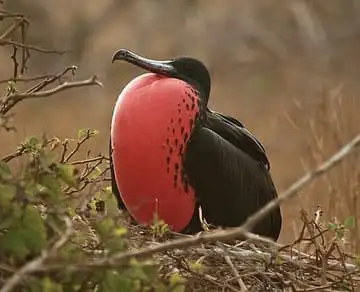
The magnificent frigatebird has a wingspan of nearly 2.3 m yet a very light body, so it can stay aloft over the sea for days. Its feathers are not waterproof enough to land on water, and males puff out a red throat pouch like a balloon to court females.
See it on the 3D globe →At a glance
- Class
- Birds
- Diet
- Fish eater
- Weight
- about 1.3 kg
- Length
- about 1 m
- Conservation status
- Least Concern (IUCN LC)
- Habitat
- coasts, open ocean
Quick answers
Where does the Magnificent frigatebird live?
It lives in coasts, open ocean of the Pacific and Atlantic oceans.
How big is the Magnificent frigatebird?
It grows to about 1 m and 1.3 kg.
What does the Magnificent frigatebird eat?
Its diet: fish eater.
Is the Magnificent frigatebird endangered?
It is listed as Least Concern (IUCN LC).
The magnificent frigatebird is a big seabird of warm ocean waters. It is the largest of the frigatebirds, about 89 to 114 centimetres long, with a wingspan of 2.17 to 2.44 metres. It lives along the coasts of the Americas, on the Galápagos Islands and on the Cape Verde islands in the Atlantic.
It has long narrow wings, a deeply forked tail and a very light body, so it can glide for a long time and is one of the fastest birds, reaching up to 153 kilometres per hour. Males have a red throat sac that they blow up like a balloon to attract a mate. Frigatebirds mostly catch fish, often flying fish, from the sea surface while flying, and they sometimes chase other birds until they give up their food.
How does it find food?
A frigatebird does not swim or dive. It snatches fish from the surface of the sea as it flies by, and flying fish are a favourite. It also practises kleptoparasitism, a long word for stealing: it harasses other seabirds in the air until they cough up their catch, then grabs the food. Its light body and huge wings let it stay in the air with very little effort, which helps it search wide stretches of ocean.
Why does the male puff up his throat?
The male has a bare red throat sac, called a gular sac. During courtship he inflates it into a large, bright red balloon to show off to females. The female is a little larger than the male and has a white breast and belly. There are two subspecies: one nests on the Galápagos Islands, and another breeds on islands off Mexico and Central America, in the tropical Atlantic and in the Cape Verde islands. Scientists split them in 2022 after finding that the Galápagos birds are genetically and physically different.
Fun facts
- Males puff up a huge red throat pouch like a balloon to attract females.
- Frigatebirds can reach speeds of up to about 153 kilometres per hour.
- A male blows up his red throat sac like a balloon to attract a female.
- It steals food from other birds in mid-air.
On the globe
The toy model shows the frigatebird over the sea with its long wings and forked tail. Look for the red throat pouch.
Quiz time
Which is heavier: Magnificent frigatebird or Harpy eagle?
Show the answer
Harpy eagle. (1.3 kg vs 6 kg) Harpy eagle →
More like this

.jpg)
Sources
Updated: 2026-10-14