
Arapaima
아라파이마
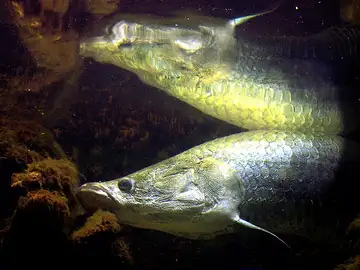
One of the largest freshwater fish, the arapaima grows to about 2–3 m in the Amazon basin. Besides gills it gulps air with a modified swim bladder, so it surfaces to breathe every few minutes.
See it on the 3D globe →At a glance
- Class
- Fish
- Lives in
- Amazon basin, South America
- Diet
- Fish eater
- Length
- about 2 m
- Conservation status
- Data Deficient (IUCN DD)
- Habitat
- rivers & lakes, rainforests
Quick answers
Where does the Arapaima live?
It lives in rivers & lakes, rainforests. On the globe you can find it near Amazon basin, South America.
How big is the Arapaima?
It grows to about 2 m.
What does the Arapaima eat?
Its diet: fish eater.
Is the Arapaima endangered?
It is listed as Data Deficient (IUCN DD).
The arapaima, also called pirarucu or paiche, lives in the rivers and flooded forests of the Amazon and Essequibo basins in South America. It is one of the largest freshwater fish in the world and can reach up to 3 metres long. Its name pirarucu comes from the Tupi language and means 'red fish'.
The arapaima has a special trick. Besides gills, it has a modified swim bladder that works like a lung, so it must come up to gulp air every few minutes. It is an important food fish, and overfishing and habitat loss have made it less common in its native range. Fish longer than 2 metres are now rarely found in the wild.
One fish or several?
For a long time the arapaima was thought to be a single species, Arapaima gigas. Scientists now recognise several, though that species is known mostly from old museum specimens. The one usually seen and studied is Arapaima arapaima. Another species, Agassiz's arapaima, is known only from old drawings, because its type specimen was lost in the bombing of World War II. Since these fish do not migrate, scientists suspect more species are still waiting to be found.
A big, armoured, air-breathing fish
The arapaima is torpedo-shaped, with large blackish-green scales and red markings. It can weigh over 100 kg, and the longest verified length is 3.07 metres. Its scales have a hard outer layer on top of layers of tough fibres arranged like plywood, which lets the fish bend while staying protected. It breathes air through lung-like tissue, so it can survive in oxygen-poor lakes and, in dry seasons, becomes the top predator there. It eats fish, crustaceans, fruit, seeds and insects, and small animals near the shore.
Family life
Arapaima build a nest about 50 cm wide in muddy bottoms when the water is low or just beginning to rise. When the flood arrives the eggs hatch, and the young have the flood season, from May to August, to grow. The male keeps the young safe in his mouth, and the female circles them to chase off enemies. Fossils about 23 million years old show that arapaima are among the oldest freshwater fish known.
Fun facts
- It must surface to gulp air about every 5 to 15 minutes.
- Its scales are tough enough to resist piranha bites.
- Pirarucu means 'red fish' in the Tupi language.
- The type specimen of one species was lost in World War II bombing.
On the globe
The model shows a long freshwater giant of the Amazon. Notice its long body, which can reach 2 to 3 metres.
Quiz time
Which is longer: Arapaima or Queen angelfish?
Show the answer
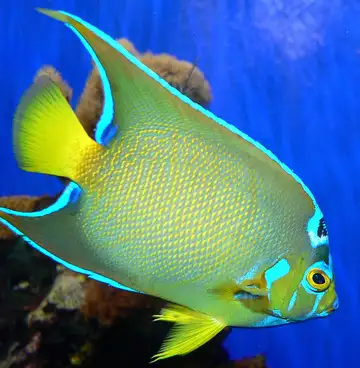
Arapaima. (2 m vs 0.45 m) Queen angelfish →
More like this

Sources
Updated: 2026-10-14