
Electric eel
전기뱀장어

Despite its name it is a knifefish, not a true eel. Most of its body is electric organ, able to deliver about 860 volts to stun prey, and it rises often to gulp air.
See it on the 3D globe →At a glance
- Class
- Fish
- Lives in
- Amazon and Orinoco basins, South America
- Diet
- Fish eater
- Length
- about 2 m
- Lifespan
- up to about 20 years
- Conservation status
- Least Concern (IUCN LC)
- Habitat
- rivers & lakes
Quick answers
Where does the Electric eel live?
It lives in rivers & lakes. On the globe you can find it near Amazon and Orinoco basins, South America.
How big is the Electric eel?
It grows to about 2 m.
What does the Electric eel eat?
Its diet: fish eater.
How long does the Electric eel live?
It can live up to about 20 years.
Is the Electric eel endangered?
It is listed as Least Concern (IUCN LC).
Electric eels are freshwater fish of South America that can stun their prey with electric shocks of up to 860 volts. Despite the name they are not true eels. They are members of the knifefish order, Gymnotiformes. Their electrical powers were first studied in 1775, and this work helped lead to the invention of the electric battery in 1800.
They are long, stout and cylinder-shaped, with smooth, scaleless skin that is brown to black on top and yellow or red underneath. One kind, Electrophorus electricus, can reach 2 metres and 20 kg. Until 2019 the genus was thought to hold one species, but it was then split into three: E. electricus, E. voltai and E. varii. E. voltai is the strongest bioelectricity generator in nature. Electric eels are nocturnal, mostly eat fish, and have poor eyesight, which they make up for by sensing electricity.
Where they live
The three species mostly live in different parts of northern South America. E. electricus is in the Guiana Shield in the north, E. voltai lives in the south, and E. varii lives mainly in the central lowlands. They stay on muddy river bottoms and sometimes in swamps, and like deep shade. They can put up with water that has little oxygen because they swim to the surface to breathe air.
Breathing air
Electric eels get most of their oxygen by gulping air at the surface about every two minutes and passing it over a richly blood-fed lining inside the mouth. Their tiny gills do not work when they take in air, and most carbon dioxide leaves through the skin. They can survive on land for some hours as long as the skin stays wet. They also keep growing for their whole lives, adding more vertebrae. Some captive eels have lived more than 20 years.
Hunting in packs
Electric eels hunt mostly fish, such as armoured catfish. E. voltai has even been seen hunting in groups: members herd a shoal of tetras into a tight bunch and then strike together. One was found with a caecilian, a legless amphibian, in its stomach. All their important organs are packed into the front fifth of the body, away from the electric organs, which fill the rest.
Fun facts
- It can deliver shocks of up to 860 volts.
- It is not a true eel but a type of knifefish.
- It gulps air about every two minutes.
- Some electric eels hunt in teams.
On the globe
The model shows a long, dark fish with a pale underside, as in the card. Look at the long body.
Quiz time
Which is longer: Electric eel or Queen angelfish?
Show the answer
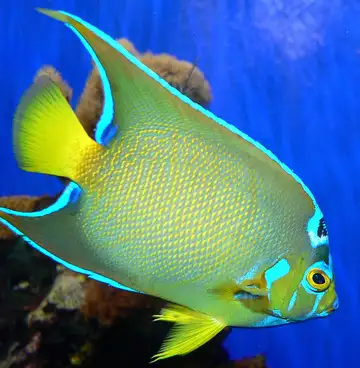
Electric eel. (2 m vs 0.45 m) Queen angelfish →
More like this

Sources
Updated: 2026-10-14