
Atlantic horseshoe crab
투구게
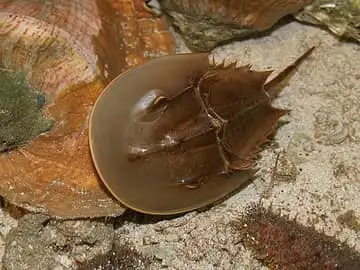
A sea animal closer to spiders than to true crabs, little changed for some 450 million years and often called a living fossil. Its copper-rich blue blood is used to test whether medicines are contaminated with bacteria.
See it on the 3D globe →At a glance
- Class
- Other animals
- Diet
- Meat eater (carnivore)
- Conservation status
- Vulnerable (IUCN VU)
- Habitat
- coasts
Quick answers
Where does the Atlantic horseshoe crab live?
It lives in coasts of the Atlantic Ocean.
What does the Atlantic horseshoe crab eat?
Its diet: meat eater (carnivore).
Is the Atlantic horseshoe crab endangered?
It is listed as Vulnerable (IUCN VU).
The Atlantic horseshoe crab lives along the Atlantic coast of North America and in the Gulf of Mexico. Despite its name it is not a crab. It is a marine arthropod that is more closely related to spiders and scorpions, and the card on the globe calls it a living fossil because it has changed little for some 450 million years.
Delaware Bay is the main place where large numbers gather each year to lay eggs. Those eggs are an important meal for shorebirds, and juveniles and adults are eaten by sea turtles. The species is listed as Vulnerable.
Body and eyes
A horseshoe crab has a horseshoe-shaped shell that is green-grey to dark brown, a middle part and a long tail spike. Females are bigger than males, and can reach about 60 centimetres including the tail and weigh up to 4.8 kilograms. It has two large compound eyes plus several small ones, which help it sense light and movement. The scientific name Limulus means askew, and polyphemus refers to a one-eyed giant, an old mistake because the animal has many eyes.
Blue blood and people
Native Americans ate the eggs, and today the crabs are caught for fishing bait, science and medicine. Their blue blood is used to make a test for bacteria, called Limulus amebocyte lysate, which checks whether medicines and vaccines are clean. Because of this, protecting horseshoe crabs helps both wildlife and people.
Fun facts
- Its blue blood is used to test medicines and vaccines for bacterial contamination.
- Horseshoe crabs are closer to spiders than to true crabs.
- Their eggs feed many migrating shorebirds.
- The blue blood is used to test medicines for bacteria.
On the globe
Find it off the Atlantic coast of North America; the card explains why this sea animal is called a living fossil.
More like this
.jpg)
Sources
Updated: 2026-10-14