
Comb jelly
빗해파리
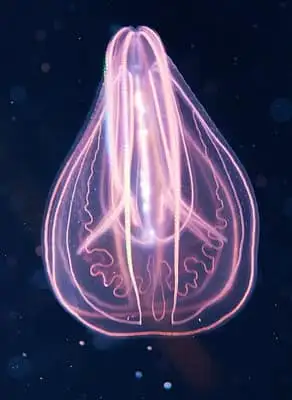
A transparent sea animal that, unlike a true jellyfish, does not sting; it swims by beating eight rows of comb-like cilia. The cilia split light into shimmering rainbows, and some species glow in the dark.
See it on the 3D globe →At a glance
- Class
- Other animals
- Diet
- Meat eater (carnivore)
- Habitat
- open ocean, coasts
Quick answers
Where does the Comb jelly live?
It lives in open ocean, coasts of the Pacific, Atlantic, Indian, Arctic and Southern oceans.
What does the Comb jelly eat?
Its diet: meat eater (carnivore).
Comb jellies, or ctenophores, are a group of marine animals that look like jellyfish but are not true jellyfish and do not sting. They swim by beating rows of tiny hairs called cilia, which are lined up in bands like combs. The name Ctenophora comes from Greek words meaning 'comb-bearing'. There are 186 recognised living species, living in oceans all over the world.
Adults range from a few millimetres to about 1.5 metres long, which makes them the largest animals that swim using cilia. Their bodies are mostly clear jelly with a thin layer of cells on the outside and inside. Most have eight comb rows running down the body. Almost all are predators that eat anything from tiny larvae to small crustaceans, and some produce light, a kind of bioluminescence.
Not true jellyfish
Comb jellies resemble jellyfish because both have a jelly-like layer between two layers of cells. But true jellyfish are cnidarians, and they sting with special cells. Comb jellies instead have colloblasts, sticky cells that glue to prey, though a few species lack them. More than 80 different cell types have been found in comb jellies, more than in sponges or cnidarians.
Different shapes
The group has many body plans. Cydippids are egg-shaped, with a pair of long sticky tentacles that can be pulled back. Platyctenids are flat and usually have no combs. Beroids have big mouths and eat other comb jellies. Coastal species are tough enough for waves and drifting sand, while some ocean species are so fragile that they are hard to catch whole, so they are mostly known from photographs.
An ancient lineage
Fossils thought to be ctenophores appear as far back as the early Cambrian, about 525 million years ago. Where comb jellies belong on the tree of life is still debated: some biologists place them as the second-earliest branch of animals, after sponges, but others think they split off even earlier. Because they are so different from other animals, they interest scientists a great deal.
Fun facts
- Comb jellies are not true jellyfish and do not sting; they swim by beating rows of tiny hairs called cilia.
- Comb jellies are the largest animals that swim with cilia.
- They have sticky cells, not stinging cells, to catch food.
- Fossils that may be comb jellies are about 525 million years old.
- Some species make their own light.
On the globe
The model shows a glassy comb jelly with shimmering rows, as in the card. Look at the rows along its body.
More like this

Sources
Updated: 2026-10-14