
Giant tube worms
자이언트 관벌레
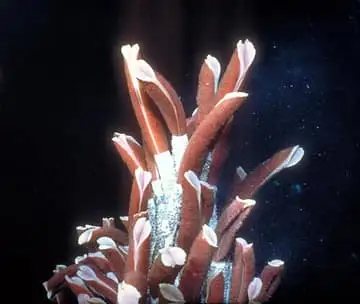
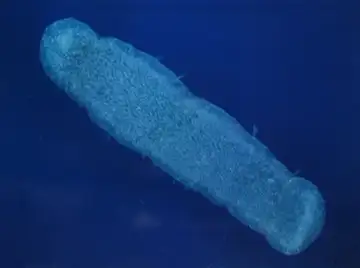
The giant tubeworm lives around deep-sea hydrothermal vents where sunlight never reaches, growing over 2 m long. It has no mouth or gut: bacteria inside it turn vent chemicals into food. Its red plume is coloured by blood.
See it on the 3D globe →At a glance
- Class
- Other animals
- Habitat
- deep sea
Quick answers
Where does the Giant tube worms live?
It lives in deep sea of the Pacific Ocean.
The giant tubeworm, Riftia pachyptila, lives on the deep-sea floor around hydrothermal vents, cracks in the seabed that spew hot, mineral-rich water. Vent fields in the East Pacific Rise and the Galápagos Rift are home to dense clusters of these worms, and a patch can stretch tens of metres across.
An adult can grow up to about 3 metres long inside a white tube that it builds itself, with a bright red plume sticking out of the top. The worm was first found in 1977 near the Galápagos Rift, and it surprised scientists because it has no mouth and no stomach. Seeing them crowded together around a vent looks like a forest of white pipes topped with red feathers, in a place that has no sunlight at all.
How does it eat without a mouth?
Inside the worm lives a huge number of bacteria that can use chemicals such as hydrogen sulfide from the vent water to make energy, a process called chemosynthesis. The worm gives the bacteria a safe home and takes up the chemicals they need, and in return it is fed by them.
Its red plume is full of blood, which helps carry the vent chemicals and oxygen to the bacteria. That is why the plume looks so red. The vents give off hydrogen sulfide, which is poisonous to most animals, so this partnership between worm and bacteria lets it thrive where almost nothing else could.
Why is it a record holder?
Riftia has the fastest growth rate known among marine invertebrates. A worm can settle at a new site, reach adulthood and grow to about 1.5 metres in less than two years.
The vents it lives beside are warm, with surrounding water between 2 and 30 degrees Celsius, in a place where sunlight never reaches. Its name pachyptila means 'thick feather', a reference to the plume at the front of the worm.
Fun facts
- It has no mouth or gut; bacteria living inside it make food from chemicals in the vent water.
- It has no mouth or stomach as an adult; bacteria inside it make its food.
- It was first seen in 1977 by scientists exploring the Galápagos Rift.
- It can grow to 1.5 metres in under two years, the fastest of any known marine invertebrate.
On the globe
The model shows a thicket of white tubes with red plumes around a deep-sea vent.
More like this
_(Ifremer_00530-64223_-_52381).jpg)
Sources
Updated: 2026-10-14