
Baird's tapir
베어드맥
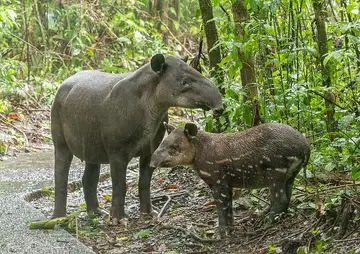
Baird's tapir is the largest land mammal of Central America, recognised by its short flexible snout and pale cheek patches. It eats leaves, fruit and shoots in tropical forests and swamps, and swims well. Calves have white stripes and spots on brown fur that hide them in the forest.
See it on the 3D globe →At a glance
- Class
- Mammals
- Lives in
- Honduras and Central America
- Diet
- Plant eater (herbivore)
- Weight
- about 250 kg
- Length
- about 2 m
- Conservation status
- Endangered (IUCN EN)
- Habitat
- rainforests, forests, wetlands
Quick answers
Where does the Baird's tapir live?
It lives in rainforests, forests, wetlands. On the globe you can find it near Honduras and Central America.
How big is the Baird's tapir?
It grows to about 2 m and 250 kg.
What does the Baird's tapir eat?
Its diet: plant eater (herbivore).
Is the Baird's tapir endangered?
It is listed as Endangered (IUCN EN).
Baird's tapir is the largest tapir in the Americas and the largest native land mammal in both Central and South America. It is also called the Central American tapir and lives from Mexico through Central America to northwestern South America. It is about the size of a small donkey, with a short, flexible snout and cream-coloured marks on the face, throat and ear tips. It is the national animal of Belize, where it is called the mountain cow.
It lives in many kinds of places: mangroves, marshes, swamps, wet tropical rainforest, drier woodland and mountainous cloud forest, from sea level up to about 3,600 metres. It prefers secondary forest when it can find it, because there is more food and cover there. The animal is named after the American naturalist Spencer Fullerton Baird, who travelled to Mexico in 1843 and saw it.
Body and snout
Adults average about 2 metres long, stand 73 to 120 cm tall and weigh 150 to 300 kg. The stubby tail is only 5 to 13 cm. The snout and upper lip stretch into a fleshy, flexible trunk, which is the tapir's strongest sense organ for finding food. The short, slender legs are good for pushing quickly through undergrowth. There are four toes on each front foot and three on each back foot.
Habits and food
The tapir may be active at any hour but is mostly nocturnal. It follows well-worn paths that zigzag through the undergrowth, eating leaves, twigs, flowers, grasses and fallen fruit, and it stays close to water. It likes to swim and wade, and on hot days it may rest in a pool for hours with just its head above water. When in danger it heads for water. Cleaner birds such as black vultures pick ticks from its fur, and seeds that pass through its gut may sprout more easily.
Growing up
A calf is born after about 400 days and weighs around 9.4 kg. Its reddish-brown coat is marked with white spots and stripes, which hide it in the shady forest and fade as it grows. For the first week the mother hides it and returns to nurse it. At three weeks the calf can already swim. Weaning comes after a year, and tapirs can live more than 30 years. Parents form long-term pairs and can communicate with shrill whistles and squeaks.
Fun facts
- It is the national animal of Belize and the largest native land mammal of Central America.
- It is the national animal of Belize.
- Calves have white stripes and spots that fade as they grow.
- It lives from sea level up to about 3,600 metres.
- In the Lacandon language its name means 'jungle horse'.
On the globe
The model shows a stocky tapir with a short snout and pale cheeks, as in the card. Look at its flexible nose.
Quiz time
Which is heavier: Baird's tapir or Geoffroy's spider monkey?
Show the answer
Baird's tapir. (250 kg vs 7.5 kg) Geoffroy's spider monkey →
More like this
.jpg)
Sources
Updated: 2026-10-14