
Kinkajou
킨카주
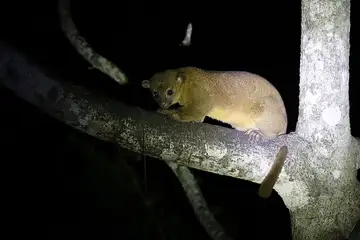
A nocturnal relative of the raccoon living in Central and South American rainforests. It has golden fur and a prehensile tail, and licks nectar and fruit with a long tongue. It is sometimes called the honey bear.
See it on the 3D globe →At a glance
- Class
- Mammals
- Lives in
- Panamanian rainforest
- Diet
- Eats both plants and meat (omnivore)
- Weight
- about 3 kg
- Conservation status
- Least Concern (IUCN LC)
- Habitat
- rainforests
Quick answers
Where does the Kinkajou live?
It lives in rainforests. On the globe you can find it near Panamanian rainforest.
How big is the Kinkajou?
It grows to about 3 kg.
What does the Kinkajou eat?
Its diet: eats both plants and meat (omnivore).
Is the Kinkajou endangered?
It is listed as Least Concern (IUCN LC).
The kinkajou, Potos flavus, is a rainforest mammal of Mexico, Central America and South America. Although it climbs like a monkey, it belongs to the raccoon family, along with olingos, coatis and raccoons. It is the only member of its genus. It has golden-brown fur, a round head, large eyes and a long prehensile tail that grips branches, and it is also called the honey bear.
A kinkajou measures about 82 to 133 cm including the tail, and weighs 1.4 to 4.6 kg. It lives in closed-canopy forests from sea level up to about 2,500 metres, from southern Mexico to Bolivia and the Atlantic Forest of Brazil. It is strictly nocturnal, so people seldom see it, and in captivity it may live up to 40 years. It is considered of least concern, but it depends on healthy forest.
A fruit-eating night climber
The kinkajou spends most of its life in trees. Its short-haired tail works like a fifth hand for climbing, though not for holding food. It can rotate its ankles and feet 180 degrees, so it can run backward along branches and climb down head-first. Scent glands on the mouth, throat and belly mark its territory and travel routes.
About 90 percent of its diet is fruit, mostly ripe figs. It holds soft fruit in its forepaws and scoops out the pulp with its tongue. The rest is leaves, flowers, nectar, herbs, and sometimes ants and other insects, or eggs.
Tongue, nectar and seeds
The kinkajou's slender tongue can stick out about 13 cm. It helps the animal reach fruit and lick nectar from flowers, so it may act as a pollinator. By eating fruit and moving around the forest, it may also spread seeds.
Its habits resemble those of daytime spider monkeys: the two fill similar roles where they overlap, but at different times of day. Kinkajous sometimes forage alongside olingos, but the bigger kinkajous drive olingos away when food is scarce.
Night life and family
Kinkajous are most active between about 7 pm and midnight, and again an hour before dawn. By day they sleep in tree hollows or in shady tangles of leaves. They sleep in family groups and groom one another.
They breed all year and have one baby, occasionally two, after a pregnancy of 112 to 118 days. They are hunted for the pet trade, for skins made into wallets and saddles, and for meat. Honduras lists the species in CITES Appendix III, so exports from there need a permit.
Fun facts
- It looks like a monkey but is a relative of the raccoon, with a gripping tail and a long tongue for nectar.
- It can turn its feet around 180 degrees to climb down trees head-first.
- The name kinkajou comes from a French form of an Algonquian word for the wolverine.
- Its other names include honey bear, night ape and night walker.
- About 90 percent of its diet is fruit.
On the globe
Look in the rainforest of Panama; the card shows the golden fur and gripping tail.
Quiz time
Which is heavier: Kinkajou or Mantled howler?
Show the answer
Mantled howler. (3 kg vs 6 kg) Mantled howler →
More like this

Sources
Updated: 2026-10-14