
Mantled howler
짖는원숭이
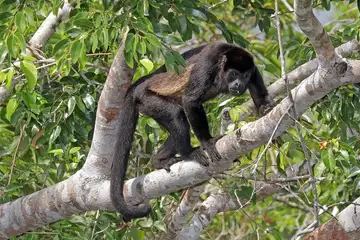
A large monkey of Central and northwestern South American rainforests. Males have an enlarged throat bone that makes roars audible from about 5 km away, and a prehensile tail grips branches like a fifth limb.
See it on the 3D globe →At a glance
- Class
- Mammals
- Lives in
- Central American rainforest
- Diet
- Plant eater (herbivore)
- Weight
- about 6 kg
- Length
- about 1.1 m
- Habitat
- rainforests
Quick answers
Where does the Mantled howler live?
It lives in rainforests. On the globe you can find it near Central American rainforest.
How big is the Mantled howler?
It grows to about 1.1 m and 6 kg.
What does the Mantled howler eat?
Its diet: plant eater (herbivore).
The mantled howler, Alouatta palliata, is a big New World monkey from Central America and northwestern South America. It is one of the monkeys most often seen and heard in the wild in Central America. The name comes from the long yellow or golden-brown guard hairs on its sides, called a mantle, which stand out against its mostly black fur.
Adult males weigh 4.5 to 9.8 kg and females 3.1 to 7.6 kg, and the grasping tail is about as long as the body. It is the only Central American monkey that eats lots of leaves, so it spends most of each day resting and sleeping. Males have an enlarged hollow bone near the vocal cords that makes their calls louder, which is where the name howler comes from.
Why it howls
Leaves are hard to digest and give little energy, so the howler saves effort. Instead of moving around to find other groups, males howl so that groups can locate each other without wasting energy or risking a fight.
Groups do not defend a private territory. Their home ranges overlap, and a group usually travels no more than about 750 metres a day. If two groups do meet, each tries to chase off the other.
Group life
Groups often have 10 to 20 members, with one to three adult males and five to ten adult females, but some have over 40. Higher-ranking animals get first pick of food and resting places, and the top male has first claim to mates.
Most young of both sexes leave the group they were born in, so the adults in a group are mostly unrelated. Grooming is rare and mostly goes from dominant monkeys to lower-ranking ones. There are three recognised subspecies, found from Mexico down to Ecuador and Peru.
Eating leaves, helping forests
Leaves make up about half to three-quarters of the diet. Howlers choose young leaves, which carry fewer toxins and are easier to digest. Big salivary glands help break down leaf tannins. When fruit is plentiful it can be up to half the diet, and figs are a favourite.
By eating fruit and spreading seeds, howlers help the rainforest regrow. They also cope with deforestation better than many monkeys, because leaves are common and they can live in small areas.
Fun facts
- Its loud howls can be heard kilometres away through the forest.
- Males have a hollow throat bone that makes their howl louder.
- Almost every mantled howler has full three-colour vision, unlike most other New World monkeys.
- The name palliata comes from the pallium, a cloak worn in ancient Greece and Rome.
- Groups travel only about 750 metres a day because leaves give so little energy.
On the globe
Find it in the Central American rainforest; the card shows the prehensile tail that grips branches.
Quiz time
Which is heavier: Mantled howler or Baird's tapir?
Show the answer
Baird's tapir. (6 kg vs 250 kg) Baird's tapir →
More like this


.jpg)
Sources
Updated: 2026-10-14