
Bengal tiger
벵골호랑이
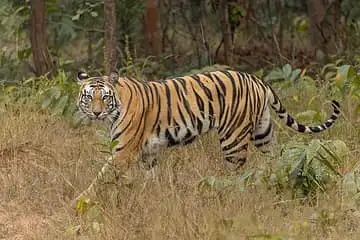
India's national animal, whose stripes are unique to each tiger, like fingerprints. It is the largest wild cat, up to about 3 m long and over 200 kg, and unlike most cats it loves to swim and cool off in water.
See it on the 3D globe →At a glance
- Class
- Mammals
- Lives in
- Central India
- Diet
- Meat eater (carnivore)
- Weight
- about 180 kg
- Length
- about 2.7 m
- Top speed
- about 65 km/h
- Lifespan
- up to about 26 years
- Conservation status
- Endangered (IUCN EN)
- Habitat
- forests, grasslands, wetlands
Quick answers
Where does the Bengal tiger live?
It lives in forests, grasslands, wetlands. On the globe you can find it near Central India.
How big is the Bengal tiger?
It grows to about 2.7 m and 180 kg.
What does the Bengal tiger eat?
Its diet: meat eater (carnivore).
How fast is the Bengal tiger?
It can reach about 65 km/h.
How long does the Bengal tiger live?
It can live up to about 26 years.
Is the Bengal tiger endangered?
It is listed as Endangered (IUCN EN).
The Bengal tiger is a subspecies of tiger from India, southern Nepal, Bangladesh, Bhutan and southwestern China. It is one of the largest wild cats, and the tiger is the biggest living cat species. Its coat is yellow to light orange with dark brown or black stripes, a white belly and an orange tail with black rings. Every tiger's stripes are different.
It is the national animal of both India and Bangladesh. In 2022 there were an estimated 3,167 to 3,682 Bengal tigers in India, 316 to 355 in Nepal, about 131 in Bhutan and around 125 in Bangladesh. The tiger is listed as endangered because of poaching and habitat loss. Adult males are usually 200 to 260 kilograms, and females 110 to 180.
Life of a hunter
Tigers live alone, except for mothers with cubs and pairs during mating. They hunt large animals such as wild boar, chital and sambar deer, and gaur. A female has one to five cubs after about 105 days, and young tigers become independent at around a year and a half. Unlike many cats, tigers like to swim and cool off in water.
White tigers and history
White tigers are not albinos but a rare recessive colour form. Bengal tigers used to range as far as the Indus Basin until the early 19th century, and they are thought to have reached the Indian subcontinent about 12,000 to 16,500 years ago. Today they survive in protected areas such as national parks and in the Sundarbans.
How big is a Bengal tiger?
Bengal tigers are among the biggest wild cats alive. Males measure roughly 2.8 to 3.1 metres from nose to tail tip in a central Indian reserve, females 2.5 to 2.9, and they stand about 90 to 110 centimetres at the shoulder. Males usually reach 200 to 260 kilograms. Size depends on where they live. Tigers in the Terai grasslands of Nepal can be very heavy, while females in the Sundarbans mangroves of Bangladesh weigh only about 75 to 80 kilograms, probably because their prey there is smaller. Their canine teeth are 7.5 to 10 centimetres long, the longest of any cat.
Fun facts
- No two tigers have the same stripe pattern.
- No two tigers have exactly the same stripes.
- India and Bangladesh both have the Bengal tiger as their national animal.
- White tigers are a rare colour variation, not albinos.
- Tigers are good swimmers and love to cool off in water.
On the globe
On the toy globe the Bengal tiger prowls central India. Look for the orange coat with dark stripes.
Quiz time
Which is heavier: Bengal tiger or Sloth bear?
Show the answer
Bengal tiger. (180 kg vs 95 kg) Sloth bear →
More like this

Sources
Updated: 2026-10-14