
Nilgai
닐가이
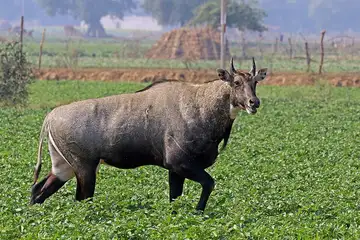
The nilgai is Asia's largest antelope; adult males have a blue-grey coat, giving it a name meaning "blue bull". It lives in grasslands and scrub of India and Nepal and stands about 1.4 metres at the shoulder.
See it on the 3D globe →At a glance
- Class
- Mammals
- Lives in
- Plains of northern India and Nepal
- Diet
- Plant eater (herbivore)
- Weight
- about 180 kg
- Conservation status
- Least Concern (IUCN LC)
- Habitat
- grasslands, savannas, forests
Quick answers
Where does the Nilgai live?
It lives in grasslands, savannas, forests. On the globe you can find it near Plains of northern India and Nepal.
How big is the Nilgai?
It grows to about 180 kg.
What does the Nilgai eat?
Its diet: plant eater (herbivore).
Is the Nilgai endangered?
It is listed as Least Concern (IUCN LC).
The nilgai (Boselaphus tragocamelus) is the largest antelope in Asia, and its name means blue cow in Hindi. It is found across the northern Indian subcontinent, with major populations in India, Nepal and the border areas of Pakistan, and especially in the Terai lowlands at the foot of the Himalayas. It is the only living member of its genus, Boselaphus.
It is a sturdy animal with thin legs, a sloping back and a deep neck with a white patch on the throat. A short crest of hair runs along the neck, and coarse hair hangs below the throat. It stands 100 to 150 centimetres at the shoulder. Males weigh 109 to 288 kilograms and are bluish-grey, while the lighter females and young are orange to tawny. Only males have horns, 15 to 24 centimetres long. The IUCN lists it as least concern.
Home and food
The nilgai likes short bushes and scattered trees in scrub forest and grassy plains, and it is common on farmland but rare in dense woods. It is a generalist that can adapt to many habitats. It feeds by day, with peaks at dawn, in the morning, in the afternoon and in the evening.
Its diet is grasses and herbs, plus woody plants in India's dry tropical forests. It is less dependent on water than many animals, though it may leave a territory if every water source dries up.
Herds and calves
Nilgai live in small groups, usually ten or fewer, though groups of 20 to 70 sometimes form. There are three kinds of group: one or two females with young calves, three to six females and yearlings with calves, and all-male groups of two to 18.
A female has one calf after eight to nine months, and sometimes twins or even triplets. The calves stay hidden for the first few weeks. Females mature at two years, but males do not breed until four or five. A wild nilgai lives about ten years. Alarmed animals gallop away up to 300 or even 700 metres rather than hiding.
Blue cow of India
Nilgai bones found at Pandu Rajar Dhibi in West Bengal suggest people hunted or kept it in the Neolithic period. For centuries, Indian villagers have linked it with the cow, which Hindus revere, and it is rarely eaten. The word nilgai was first recorded in 1882, and in the Mughal emperor Aurangzeb's time it was called nilghor, blue horse.
Today the herds are so large in some Indian states that they raid and trample crops, and farmers have asked the government to cull them. Feral nilgai are also an invasive species in Texas, where they were introduced in 1924.
Fun facts
- Asia's largest antelope; its name means 'blue cow' because adult males are bluish-grey.
- The nilgai is the only living member of the genus Boselaphus.
- Peter Simon Pallas described it in 1766.
- It has a white patch on the throat and white spots on the face.
- Its tribe of antelope began at least 8.9 million years ago and may be the least changed of all living bovids.
On the globe
The model shows a nilgai with its sloping back, bluish-grey coat and white throat patch.
Quiz time
Which is heavier: Nilgai or Sloth bear?
Show the answer
Nilgai. (180 kg vs 95 kg) Sloth bear →
More like this
_male.jpg)
Sources
Updated: 2026-10-14