
Bighorn sheep
큰뿔양
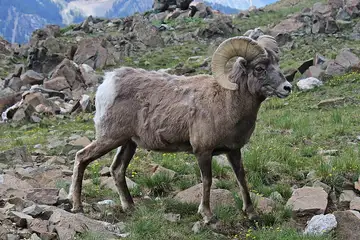
The bighorn sheep is a wild sheep of the mountains of western North America. Males carry huge curled horns that can weigh over 14 kilograms. During the breeding season, rams charge and crash their heads together to settle rank, and the sound carries far.
See it on the 3D globe →At a glance
- Class
- Mammals
- Lives in
- Rocky Mountains near Alberta
- Diet
- Plant eater (herbivore)
- Conservation status
- Least Concern (IUCN LC)
- Habitat
- mountains, deserts
Quick answers
Where does the Bighorn sheep live?
It lives in mountains, deserts. On the globe you can find it near Rocky Mountains near Alberta.
What does the Bighorn sheep eat?
Its diet: plant eater (herbivore).
Is the Bighorn sheep endangered?
It is listed as Least Concern (IUCN LC).
The bighorn sheep is a wild sheep of the mountains of western North America. It is named for the huge horns of the males, a pair of which can weigh up to 14 kilograms, while the whole sheep usually weighs up to about 143 kilograms.
Its ancestors crossed from Siberia into Alaska over the Bering land bridge, and later spread south as far as Baja California and northwestern Mexico. Native American stories include the bighorn, and today it is a symbol of wild mountain country. These sheep are named for the horns, but the males' horns are not only for show. The horns grow throughout life and curl around in a spiral.
Where does it live?
Bighorns live in mountains and deserts from southwestern Canada to Mexico. Scientists group them into mountain and desert forms, and recent genetic tests point to three distinct subspecies, one of which, the Sierra Nevada bighorn, is endangered. Their close cousin the Dall sheep lives farther north, in Alaska and northwestern Canada. In rocky country the bighorn escapes danger by climbing steep cliffs where predators cannot follow. Its hooves grip stony ground well, and its sandy coat blends with the slopes.
A big comeback story
At one time millions of bighorns lived in North America. By 1900 only several thousand were left because of overhunting and diseases passed on by farm animals. Rams still fight by charging and clashing their horns, a loud crash that carries across the hills. One of the three subspecies, the Sierra Nevada bighorn, is endangered, and diseases passed on by livestock remain a worry.
Fun facts
- A single ram's horns can weigh as much as 14 kilograms.
- By 1900 the population had crashed to several thousand animals.
- Bighorn ancestors walked across the Bering land bridge about 750,000 years ago.
On the globe
The model shows a bighorn with big curled horns on a rocky slope. Look for it in the western mountains of North America.
More like this

Sources
Updated: 2026-10-14