
American bison
아메리카들소
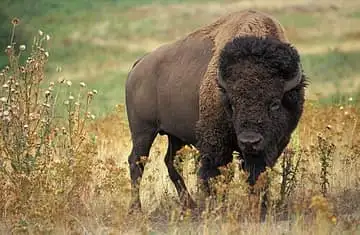
North America's heaviest land animal, the American bison weighs close to a tonne in big males and can run about 55 km/h. Tens of millions once roamed the Great Plains before hunting nearly wiped them out in the 1800s.
See it on the 3D globe →At a glance
- Class
- Mammals
- Lives in
- Great Plains, North Dakota, USA
- Diet
- Plant eater (herbivore)
- Weight
- about 600 kg
- Length
- about 3 m
- Top speed
- about 55 km/h
- Lifespan
- up to about 25 years
- Conservation status
- Near Threatened (IUCN NT)
- Habitat
- grasslands, forests
Quick answers
Where does the American bison live?
It lives in grasslands, forests. On the globe you can find it near Great Plains, North Dakota, USA.
How big is the American bison?
It grows to about 3 m and 600 kg.
What does the American bison eat?
Its diet: plant eater (herbivore).
How fast is the American bison?
It can reach about 55 km/h.
How long does the American bison live?
It can live up to about 25 years.
Is the American bison endangered?
It is listed as Near Threatened (IUCN NT).
The American bison, often called the buffalo, is the largest land mammal in North America. A grown bull can weigh about 900 kilograms and stand nearly 2 metres tall at the big hump of muscle over its shoulders. Bison have shaggy dark-brown coats, a heavy head and short, curved horns, which both males and females grow. Despite their size, they are quick on their feet and can run about 55 km/h.
Before 1800, tens of millions of bison roamed the grasslands of North America. Hunting in the 1800s nearly wiped them out, and by the end of that century fewer than 1,000 were left. Thanks to protection and careful conservation, herds have grown again in parks and reserves in the United States, Canada and Mexico. In 2016 the bison was named the national mammal of the United States.
Where it lives and what it eats
Bison once lived from Alaska to northern Mexico, mostly on prairies and grasslands, but also in forests and mountain valleys. Yellowstone National Park is the only place in the United States where bison have lived without a break since prehistoric times, and in 2025 it had nearly 5,300 of them. Bison are grazers: in Yellowstone, grasses, sedges and other grass-like plants make up more than 90 percent of what they eat. They graze in the morning and evening and rest at midday to chew their cud, which means bringing food back up to chew it again.
Family life
Bison live in herds that seem to be led by older females. Adult males spend much of the year alone or in small groups and join the herds for the mating season in summer. Then the bulls bellow, roll in the dirt and butt heads to show who is strongest. A single calf is usually born in late April or May. It is reddish-tan at first and starts turning brown after about two and a half months. After just a few days, a calf can keep up with the herd and follows its mother closely.
Is it endangered?
The bison is no longer in danger of disappearing completely, but it still needs help. The IUCN Red List, the world's main list of threatened species, rates it as Near Threatened. About 30,000 bison live in conservation herds, while around 500,000 more are raised on private ranches, much like cattle. The biggest worries today are that wild herds are small and separated from each other, that some have mixed with cattle genes, and that conservation herds now roam only about one percent of the bison's original range.
Fun facts
- In 2016 the bison became the national mammal of the United States.
- In winter, bison swing their huge heads from side to side to sweep snow off the grass, instead of digging with their hooves like many other hoofed animals.
- Bison are strong swimmers and can jump over objects about 1.5 metres high.
- Bison roll in dust and mud, in hollows called wallows, to cool off and soothe itchy insect bites.
- During the mating season, a bull can lose more than 90 kilograms because he is too busy guarding females to eat much.
- A bison's shaggy head is the best-insulated part of its body, so in a blizzard it stands facing straight into the wind.
On the globe
The model shows bison on the Great Plains of North Dakota. Look for their big shoulder humps and shaggy dark-brown coats.
Quiz time
Which is heavier: American bison or North American beaver?
Show the answer
American bison. (600 kg vs 20 kg) North American beaver →
More like this

Sources
- Read more on Wikipedia
- American bison — Wikipedia
- 아메리카들소 — 위키백과
- Bison — Yellowstone National Park (U.S. National Park Service)
- Bison — U.S. National Park Service
- American bison — Smithsonian's National Zoo
- American Bison Fact Sheet — PBS Nature
Updated: 2026-10-13