
Blue poison dart frog
독화살개구리
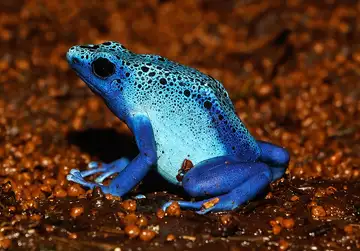
The blue poison dart frog is only about 4 to 5 cm long. Its bright blue skin with black spots warns predators that it is toxic, and it hunts ants and other small prey on the rainforest floor.
See it on the 3D globe →At a glance
- Class
- Amphibians
- Lives in
- Rainforest of southern Suriname
- Diet
- Insect eater
- Length
- about 0.04 m
- Conservation status
- Least Concern (IUCN LC)
- Habitat
- rainforests
Quick answers
Where does the Blue poison dart frog live?
It lives in rainforests. On the globe you can find it near Rainforest of southern Suriname.
How big is the Blue poison dart frog?
It grows to about 0.04 m.
What does the Blue poison dart frog eat?
Its diet: insect eater.
Is the Blue poison dart frog endangered?
It is listed as Least Concern (IUCN LC).
The dyeing poison dart frog (Dendrobates tinctorius), also called the cobalt poison frog, is a small, brightly coloured frog of the South American rainforest. It is large for a poison dart frog, usually about 5 centimetres long. The bright blue skin with black spots acts as a warning that it is toxic.
It lives in the eastern Guiana Shield, in parts of French Guiana, Guyana, Suriname and Brazil, mostly on the forest floor where it hunts ants and other small prey. It is one of the most variably coloured poison dart frogs, with more than 30 recognised colour forms. It is rated Least Concern.
Home in the rainforest
This frog lives up to about 600 metres above sea level, mostly in uplands and at the base of mountains, though some populations live near sea level. It is often found where a tree has fallen and made a gap in the canopy. Water that collects in the fallen trunk becomes a tiny pool where tadpoles can grow. Males are usually smaller and more slender than females, and their toe discs are heart-shaped while the females' are round. Females also have a more arched back.
Poison from food
Bright colours tell predators to stay away. The frog's poison does not come from inside its own body: in the wild it comes from the food the frog eats, so frogs raised in captivity lose their toxicity. The name tinctorius, 'dyeing', comes from a legend that some Indigenous groups used frog poison to change the colour of parrot feathers.
Fun facts
- Its bright blue skin warns predators that it is poisonous; in captivity it loses its poison because the toxin comes from its wild diet.
- More than 30 colour forms of this frog are recognised.
- Its poison comes from its wild diet, so captive frogs lose it.
- Its species name 'tinctorius' means 'dyeing', after an old legend about parrot feathers.
On the globe
The model shows a blue poison dart frog in the rainforest of southern Suriname. Look for its bright blue skin and black spots.
Quiz time
Which is longer: Blue poison dart frog or Axolotl?
Show the answer
Axolotl. (0.04 m vs 0.23 m) Axolotl →
More like this

Sources
Updated: 2026-10-14