
Axolotl
아홀로틀
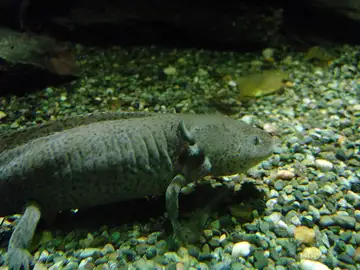
A salamander native only to the lakes near Mexico City. It keeps its feathery external gills for life and can regrow lost limbs and parts of organs. Wild numbers are critically low.
See it on the 3D globe →At a glance
- Class
- Amphibians
- Lives in
- Lake Xochimilco, Mexico City
- Diet
- Meat eater (carnivore)
- Weight
- about 0.15 kg
- Length
- about 0.23 m
- Lifespan
- up to about 15 years
- Conservation status
- Critically Endangered (IUCN CR)
- Habitat
- rivers & lakes
Quick answers
Where does the Axolotl live?
It lives in rivers & lakes. On the globe you can find it near Lake Xochimilco, Mexico City.
How big is the Axolotl?
It grows to about 0.23 m and 0.15 kg.
What does the Axolotl eat?
Its diet: meat eater (carnivore).
How long does the Axolotl live?
It can live up to about 15 years.
Is the Axolotl endangered?
It is listed as Critically Endangered (IUCN CR).
The axolotl is a salamander that never grows up in the usual way. It stays in the water all its life and keeps its feathery external gills, a trait called neoteny. It lives naturally only in the lakes and canals of the Mexican highlands, in places such as Xochimilco near Mexico City.
In the wild it is critically endangered, with perhaps only 50 to 1,000 adults left. Its lakes were drained, first by the Aztecs and then much more in the 20th century, and invasive fish such as tilapia and carp eat them. A large captive population is used in laboratories and aquariums.
A name and a lake
Axolotl is a Nahuatl word that has been translated in many ways, from 'water servant' to 'water dog'. It refers to the Aztec god Xolotl, who was the twin of Quetzalcōātl and ruled over fire, lightning, dogs and the dead. Axolotls once lived in a chain of connected lakes: Xochimilco and Chalco, and probably Texcoco and Zumpango. Much of that area is now Mexico City.
What an axolotl looks like
An adult is 15 to 45 cm long, though about 23 cm is most common. It has a wide head, eyes with no lids and three pairs of feathery gills that move oxygen-rich water. It feeds by suction. Wild axolotls are brown or tan with gold speckles, but captive ones come in other colours: pale pink with black eyes, grey, white with red eyes, or black.
Super healing
Axolotls can regrow parts of their bodies, including limbs, gills and parts of their eyes and brains. This is why scientists study them as a model animal. Learning how an axolotl heals so well may one day help people understand how to repair injuries. They are also kept in zoos, aquariums and as pets, and they inspire characters in books and games.
Fun facts
- It keeps its feathery gills all its life and can regrow lost legs, its tail and even parts of its heart.
- It keeps its feathery gills for life.
- It can regrow lost limbs.
- Only about 50 to 1,000 adults are thought to live in the wild.
- The name comes from the Nahuatl language.
On the globe
The model shows a salamander with feathery gills on both sides of its head, as in the card. The gills never go away.
Quiz time
Which is longer: Axolotl or Red-eyed tree frog?
Show the answer
Axolotl. (0.23 m vs 0.06 m) Red-eyed tree frog →
More like this

Sources
Updated: 2026-10-14