
Fire salamander
파이어도롱뇽
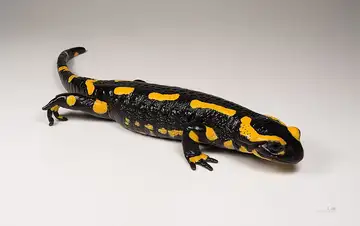
The fire salamander is a European amphibian with glossy black skin and bold yellow markings. It lives under leaf litter in damp forests and comes out on rainy nights to eat worms and insects. Glands behind the eyes release toxins, so its bright colours are a warning.
See it on the 3D globe →At a glance
- Class
- Amphibians
- Lives in
- Damp forests of central Europe
- Diet
- Meat eater (carnivore)
- Length
- about 0.2 m
- Lifespan
- up to about 50 years
- Conservation status
- Vulnerable (IUCN VU)
- Habitat
- forests
Quick answers
Where does the Fire salamander live?
It lives in forests. On the globe you can find it near Damp forests of central Europe.
How big is the Fire salamander?
It grows to about 0.2 m.
What does the Fire salamander eat?
Its diet: meat eater (carnivore).
How long does the Fire salamander live?
It can live up to about 50 years.
Is the Fire salamander endangered?
It is listed as Vulnerable (IUCN VU).
The fire salamander is a common salamander of southern and central Europe. Its glossy black skin is marked with yellow spots or stripes; some animals are almost all black and others mostly yellow, and orange or red can appear depending on the subspecies. The bright colours are a warning that the animal is toxic, a strategy called aposematism.
It is one of the largest salamanders in Europe, growing 15 to 25 cm long. It is most common at heights of 250 to 1,000 metres and is found in deciduous forests, especially hilly ones. It can live a very long time: one lived more than 50 years in a German museum. Although it is widespread and abundant, the IUCN lists it as vulnerable because an introduced fungus, Batrachochytrium salamandrivorans, has caused severe declines in parts of its range.
Forest life
Fire salamanders hide in leaf litter, under wood and around mossy tree trunks, and are active in the evening and at night. On rainy days they come out in daytime too. They need small brooks or ponds with clean water for their larvae. They eat insects, spiders, millipedes, centipedes, earthworms and slugs, and sometimes newts and young frogs. Small prey is caught with the tongue, to which it sticks.
Courtship and young
Males and females look similar except in the breeding season, when the male has a swollen gland near his vent. Courtship takes place on land. The male blocks the female's path, rubs her with his chin and slides underneath to grasp her front legs. He leaves a packet of sperm on the ground and guides her onto it. The eggs develop inside her body, and she usually places the larvae in water just as they hatch. A few subspecies give birth to fully formed young.
A warning in the skin
The skin gives off a toxin called samandarin that causes strong muscle convulsions and high blood pressure in vertebrates. Predators learn to avoid the bright pattern. The animals vary a lot: the nominate subspecies is the spotted fire salamander, S. s. terrestris is the barred fire salamander, and S. s. fastuosa is yellow-striped. Some animals once called subspecies are now treated as separate species, such as the Corsican and African fire salamanders.
Fun facts
- Its yellow-and-black skin warns predators that it can release toxic secretions.
- Its yellow-and-black skin is a warning of toxins.
- One fire salamander lived more than 50 years in a museum.
- Some subspecies give birth to fully formed young instead of larvae.
- It needs clean small streams for its larvae.
On the globe
The model shows a black salamander with bright yellow spots, as in the card. Look at the yellow pattern.
Quiz time
Which is longer: Fire salamander or Blue poison dart frog?
Show the answer
Fire salamander. (0.2 m vs 0.04 m) Blue poison dart frog →
More like this

Sources
Updated: 2026-10-14