
Chinese giant salamander
중국장수도롱뇽
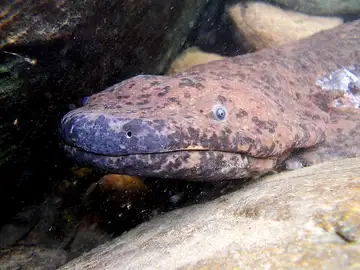
The Chinese giant salamander is one of the world's largest amphibians, up to about 1.8 metres long. It lives in cold, fast mountain streams of central and southern China, hunts at night using sensitive skin folds, and is critically endangered.
See it on the 3D globe →At a glance
- Class
- Amphibians
- Lives in
- Mountain streams of central and southern China
- Diet
- Meat eater (carnivore)
- Length
- about 1.1 m
- Conservation status
- Critically Endangered (IUCN CR)
- Habitat
- rivers & lakes, mountains
Quick answers
Where does the Chinese giant salamander live?
It lives in rivers & lakes, mountains. On the globe you can find it near Mountain streams of central and southern China.
How big is the Chinese giant salamander?
It grows to about 1.1 m.
What does the Chinese giant salamander eat?
Its diet: meat eater (carnivore).
Is the Chinese giant salamander endangered?
It is listed as Critically Endangered (IUCN CR).
The Chinese giant salamander is the largest salamander and the largest amphibian in the world by the usual count, although after the species was split up, the South China giant salamander is now said to be slightly larger. It lives only in water and is found in rocky mountain streams and lakes of the Yangtze river basin of central China. It is critically endangered in the wild.
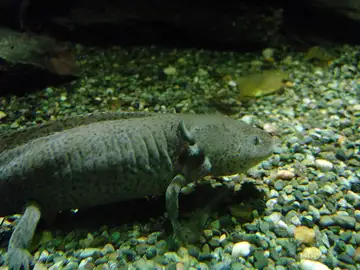
It has a large, flat head, small eyes without lids and dark, wrinkly, mottled skin. The average adult weighs 25 to 30 kg and is about 1.3 metres long. One kept on a farm in Zhangjiajie reached 1.8 metres in 2007. The wild population has fallen by an estimated 80 percent since the 1950s, because of habitat loss, pollution and over-collecting for food and traditional medicine. In Chinese it is called the 'infant fish', because its cries can sound like a crying child.
A living fossil
The giant salamander belongs to the family Cryptobranchidae, which dates back about 170 million years, so it is called a living fossil. Its relatives include the Japanese giant salamander and the much smaller North American hellbender. DNA studies in 2018 found five wild groups that split from one another 4.71 to 10.25 million years ago, and some may be separate species. In recent years some groups have been named as species of their own, for example Andrias cheni in 2023.
Hunting in the dark
Its eyesight is very poor, so it senses the faintest vibrations with special sensory nodes along its body, from head to tail. It is most active from early evening to early night. It eats crabs, fish, frogs, insects, shrimp and even a water shrew. It creeps close and then suddenly gapes its mouth, which makes water rush in and carries the prey inside. It can also make barking, hissing and crying sounds.
Protected, but in trouble
The species is protected under Chinese law and listed in CITES Appendix I. It is farmed extensively in central China, but many farmed salamanders are caught in the wild. Individuals feed little when the water is warmer than 20 degrees Celsius, and 35 degrees is deadly for them. The skin gives off a sticky white substance that repels predators. In 2008 it was named one of the top 10 focal species of the EDGE project, for animals that are both distinct and endangered.
Fun facts
- Its Chinese name means 'infant fish' because it cries like a baby.
- Its family is about 170 million years old.
- One farmed individual measured 1.8 metres.
- Its skin makes a sticky white substance that repels predators.
On the globe
The model shows a huge, wrinkly salamander with a flat head, as in the card. Look at the broad head and tiny eyes.
Quiz time
Which is longer: Chinese giant salamander or Fire salamander?
Show the answer
Chinese giant salamander. (1.1 m vs 0.2 m) Fire salamander →
More like this

Sources
Updated: 2026-10-14