
Lionfish
쏠배감펭
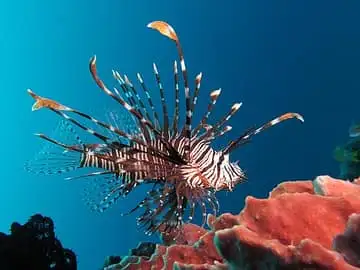
A fish with showy fan-like fins and venomous spines, native to Indo-Pacific reefs. It spreads its fins to corner small fish, then swallows them whole, and in the Caribbean it has become an invasive pest.
See it on the 3D globe →At a glance
- Class
- Fish
- Diet
- Meat eater (carnivore)
- Lifespan
- up to about 10 years
- Conservation status
- Least Concern (IUCN LC)
- Habitat
- coral reefs
Quick answers
Where does the Lionfish live?
It lives in coral reefs of the Pacific and Indian oceans.
What does the Lionfish eat?
Its diet: meat eater (carnivore).
How long does the Lionfish live?
It can live up to about 10 years.
Is the Lionfish endangered?
It is listed as Least Concern (IUCN LC).
Lionfish are venomous marine fish of the genus Pterois, native to coral reefs of the Indo-Pacific. They wear bold warning colours, brown or maroon and white stripes, and showy fan-like fins with long, separate, venomous dorsal spines. Those spines are their main defence against predators. An adult can grow to about 18 inches, roughly 45 centimetres.
Five species are recognised in the genus, and the red lionfish and the common lionfish are the most studied. Lionfish live 5 to 15 years and are popular aquarium fish. Two of them, Pterois volitans and Pterois miles, have become a significant invasive species in the western Atlantic, the Caribbean Sea and the Mediterranean Sea, where they are not native.
Looks and hunting
Besides the spines, a lionfish has fleshy tentacles above its eyes and below its mouth. Young lionfish have a special tentacle above the eye that may help to attract new prey. It also plays a role in choosing a mate.
Lionfish feed most actively in the morning. They hunt small fish, invertebrates and mollusks, using special swim-bladder muscles to control their position in the water. They blow jets of water as they approach so that the prey turns head-on to them, which makes the capture easier.
Eggs and enemies
Females release two mucus-filled egg clusters at a time, each with as many as 15,000 eggs, and can lay up to about 2 million eggs a year. Courtship is complex.
Moray eels, bluespotted cornetfish, barracuda and large groupers have been seen eating lionfish, and sharks probably can too. In Honduras, park officials tried to train sharks to eat them. Their venom can cause pain, nausea and fever in people and is dangerous, but lionfish are edible when prepared correctly.
An invasive visitor
Lionfish were probably first released off Florida by the mid-1980s, and the pattern of finds suggests the aquarium trade, perhaps pets discarded by owners. By 2001 they were seen from Georgia to Bermuda. They reached the Bahamas in 2004, Texas waters in 2011, Barbados and Venezuela in 2013, and Brazil in 2014.
About 93 percent of the invaders in the western Atlantic are the red lionfish. Larvae drift on ocean currents such as the Gulf Stream. In Texas and Florida, divers are encouraged to catch lionfish for sport and for food.
Fun facts
- Lionfish released into the Atlantic have become an invasive pest on Caribbean reefs.
- A female can lay up to about 2 million eggs a year.
- Park officials in Honduras tried to train sharks to eat lionfish.
- Lionfish blow jets of water to turn their prey toward them.
- About 93 percent of lionfish in the western Atlantic are red lionfish.
On the globe
The model shows a lionfish with its fan-like fins spread over a coral reef.
More like this

Sources
Updated: 2026-10-14