
Coelacanth
실러캔스
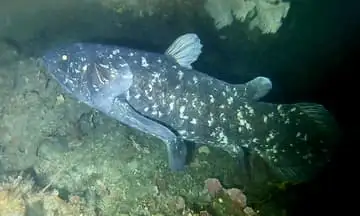
Once thought to have died out 66 million years ago, a living coelacanth was found off South Africa in 1938, earning it the name "living fossil". It grows to about 2 m and moves its limb-like fins in alternating pairs in deep water.
See it on the 3D globe →At a glance
- Class
- Fish
- Diet
- Fish eater
- Length
- about 1.8 m
- Lifespan
- up to about 100 years
- Conservation status
- Critically Endangered (IUCN CR)
- Habitat
- deep sea, caves
Quick answers
Where does the Coelacanth live?
It lives in deep sea, caves of the Indian Ocean.
How big is the Coelacanth?
It grows to about 1.8 m.
What does the Coelacanth eat?
Its diet: fish eater.
How long does the Coelacanth live?
It can live up to about 100 years.
Is the Coelacanth endangered?
It is listed as Critically Endangered (IUCN CR).
Coelacanths are an ancient group of lobe-finned fish that were thought to have died out about 66 million years ago, at the end of the Cretaceous. Then, in 1938, fishermen off the coast of South Africa caught a living one, and the world was astonished. Since then it has been nicknamed a "living fossil".
Only two living species are known today: the West Indian Ocean coelacanth, found off South Africa and the Comoro Islands, and the Indonesian coelacanth, discovered in the late 1990s. They are closer relatives of lungfish and of land animals, including us, than of ordinary fish. The Indian Ocean species is listed as Critically Endangered.
A fish that rewrote the textbooks
Fossil coelacanths go back more than 410 million years, to the Devonian period. Because the two living species look like their ancient relatives, people call them living fossils. Yet fossils show that coelacanths once had many different body shapes, including active swimmers in open water, and some moved between freshwater and saltwater. So the modern ones are not exact copies of the oldest fish, even if they look familiar.
Where it lives and how it moves
Living coelacanths are deep-water fish, resting in caves and moving about at night. They reach about 1.8 to 2 metres in length. Their paired, limb-like fins move in an alternating pattern, a bit like the legs of a walking animal. The Indonesian coelacanth lives in the seas of eastern Indonesia, and genetic studies suggest that this population might include more than one species.
Fun facts
- It was caught alive in 1938, long after scientists thought it extinct.
- Fossil coelacanths are more than 410 million years old.
- Its limb-like fins move in alternating pairs.
- Its name means "hollow spine" in Greek.
On the globe
The model is placed in the deep Indian Ocean off southern Africa. Look for the thick, limb-like fins.
Quiz time
Which is longer: Coelacanth or Sand tiger shark?
Show the answer
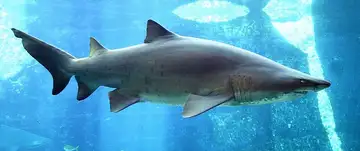
Sand tiger shark. (1.8 m vs 2.7 m) Sand tiger shark →
More like this

Sources
Updated: 2026-10-14