
Central bearded dragon
수염도마뱀
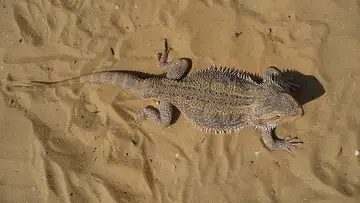
The central bearded dragon is a lizard of Australia’s dry interior. When threatened it puffs out its spiky throat pouch, the "beard", and opens its mouth wide to look bigger. It often basks on rocks and fence posts.
See it on the 3D globe →At a glance
- Class
- Reptiles
- Lives in
- Arid interior of Australia
- Diet
- Eats both plants and meat (omnivore)
- Length
- about 0.5 m
- Conservation status
- Least Concern (IUCN LC)
- Habitat
- deserts, savannas
Quick answers
Where does the Central bearded dragon live?
It lives in deserts, savannas. On the globe you can find it near Arid interior of Australia.
How big is the Central bearded dragon?
It grows to about 0.5 m.
What does the Central bearded dragon eat?
Its diet: eats both plants and meat (omnivore).
Is the Central bearded dragon endangered?
It is listed as Least Concern (IUCN LC).
The central bearded dragon, also called the inland bearded dragon, is a lizard native to eastern and central Australia. Its name comes from the pouch under its chin, which it can puff out and darken like a beard. It grows to about 60 centimetres from nose to tail tip, with the tail more than half of that, and can weigh around 550 grams. Males are generally bigger than females.
Its body is brown, tan, yellow and red, and it can shift its colour a little with its mood. It lives in semiarid and arid woodland and rocky desert, mainly in inland New South Wales, the Northern Territory, Queensland and South Australia. It is a skilled climber and spends as much time perched on branches and fence posts as on the ground. When threatened, it flattens its body, opens its mouth to show yellow inside and spreads its dark beard.
Sun and food
Bearded dragons bask on exposed branches or rocks in the morning and early evening, and retreat to shade or burrows during the hottest part of the afternoon. They eat almost anything: plants, fruit, insects, worms and sometimes a small rodent or lizard. A study of the summer diet of wild adults found that plants made up 54 percent of the food and termites with wings about 26 percent.
Talking without sound
Bearded dragons do not make calls, except for a soft hiss when threatened. They talk with colour, posture and gestures. A slow bow often means a female is giving way to a male, a fast head bob with a black beard shows a male's dominance, and a vigorous bob comes just before mating. A low-ranking lizard may wave one arm in a circle to say it gives up. Dragons are not social, but they can gather at good basking spots, where the top-ranking ones take the sunniest places.
A clever lizard
Bearded dragons can learn by watching others. In one experiment a lizard was trained to open a door to reach food, and most of those who watched were then able to do it too. They also have a parietal eye, or 'third eye', on the top of the head that senses light and helps with temperature and hormones. A 2020 study found it senses the Earth's magnetic field when light of short wavelengths enters it. Dragons are not known to attack humans.
Fun facts
- When threatened it puffs out and darkens its spiky 'beard', and it waves one arm to signal to other dragons.
- It waves one arm to signal to other dragons.
- Its spiky beard looks fierce but is soft to the touch.
- It has a 'third eye' on top of its head.
- Its skin gets darker in sunlight and lighter in darkness.
On the globe
The model shows a spiky lizard with a puffed-out 'beard', as in the card. Look at the beard under its chin.
Quiz time
Which is longer: Central bearded dragon or Thorny devil?
Show the answer
Central bearded dragon. (0.5 m vs 0.2 m) Thorny devil →
More like this

Sources
Updated: 2026-10-14