
Olive sea snake
올리브바다뱀
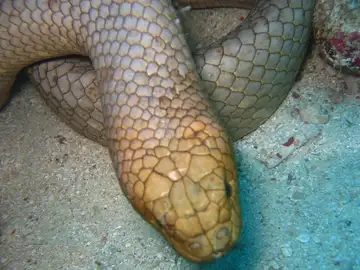
An olive-brown sea snake of the coral reefs of northern Australia and New Guinea. It swims with a flat paddle-like tail, grows to about 1.5 to 2 m, and is venomous. It even senses light through skin on its tail.
See it on the 3D globe →At a glance
- Class
- Reptiles
- Lives in
- Great Barrier Reef, Australia
- Diet
- Meat eater (carnivore)
- Length
- about 1.5 m
- Conservation status
- Least Concern (IUCN LC)
- Habitat
- coral reefs
Quick answers
Where does the Olive sea snake live?
It lives in coral reefs of the Pacific and Indian oceans. On the globe you can find it near Great Barrier Reef, Australia.
How big is the Olive sea snake?
It grows to about 1.5 m.
What does the Olive sea snake eat?
Its diet: meat eater (carnivore).
Is the Olive sea snake endangered?
It is listed as Least Concern (IUCN LC).
The olive sea snake (Aipysurus laevis) is a venomous snake that spends its whole life in the sea. It is also called the golden sea snake. Its back is brownish and purple, its belly is white, and it swims using a flat, paddle-like tail.
It lives on coral reefs in the Indo-Pacific, from Indonesia to New Caledonia, including Australia's Great Barrier Reef, and it is common and widespread there. It usually grows to about one metre, and sometimes up to two. It hides in small coves of the reef when it is not hunting or coming up for air. It is rated Least Concern.
Hunting on the reef
The olive sea snake eats crabs, prawns, fish and fish eggs. It pokes its head into cracks in the coral to find hiding prey, and it uses venom to stop the prey from moving. The venom also helps to start breaking the food down. It usually stays away from open water. Attacks on divers are rare, though a snake that feels threatened may defend itself.
Seeing with its tail
Scientists found that this snake has light-sensitive cells in the skin of its tail. They think this helps the snake notice if its tail is sticking out of its hiding place in the coral during the day. That way the whole animal can stay hidden. Animals with light-sensitive skin exist in many other groups, so the olive sea snake may not be the only sea snake that can do it.
Fun facts
- It has light-sensing cells in its paddle-shaped tail, so it can tell if its tail is sticking out of a hiding place.
- Its name Aipysurus comes from Greek words meaning 'high tail'.
- It can sense light through the skin of its tail.
- Its venom affects the muscles and nerves of its prey.
On the globe
The model shows an olive sea snake on the Great Barrier Reef in Australia. Look for its paddle-shaped tail.
Quiz time
Which is longer: Olive sea snake or Central bearded dragon?
Show the answer
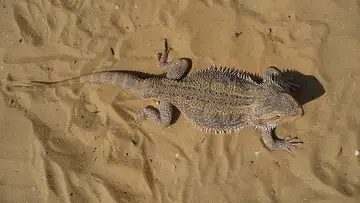
Olive sea snake. (1.5 m vs 0.5 m) Central bearded dragon →
More like this

Sources
Updated: 2026-10-14