
Common kingfisher
물총새
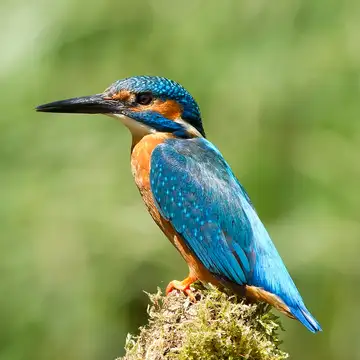
A tiny kingfisher with an electric blue back and orange belly. It perches on a branch and dives into water to snatch small fish. It is only about 16 cm long.
See it on the 3D globe →At a glance
- Class
- Birds
- Lives in
- Rivers and ponds of Southeast Asia
- Diet
- Fish eater
- Weight
- about 0.04 kg
- Length
- about 0.16 m
- Lifespan
- up to about 21 years
- Conservation status
- Least Concern (IUCN LC)
- Habitat
- rivers & lakes, wetlands
Quick answers
Where does the Common kingfisher live?
It lives in rivers & lakes, wetlands. On the globe you can find it near Rivers and ponds of Southeast Asia.
How big is the Common kingfisher?
It grows to about 0.16 m and 0.04 kg.
What does the Common kingfisher eat?
Its diet: fish eater.
How long does the Common kingfisher live?
It can live up to about 21 years.
Is the Common kingfisher endangered?
It is listed as Least Concern (IUCN LC).
The common kingfisher, Alcedo atthis, also called the Eurasian or river kingfisher, is a small, sparrow-sized bird with bright blue upperparts, orange underparts and a long, dagger-like bill. It is about 16 centimetres long, has a wingspan of 25 centimetres and weighs only 34 to 46 grams. Seven subspecies live across Eurasia and North Africa.
Many stay in the same area all year, but birds from places where rivers freeze in winter fly south, mostly at night. It lives by clear, slow rivers, ponds and lakes with plants on the banks, and in winter often moves to coasts and estuaries. Its flight is fast, direct and usually low over water, and a bird flying away shows an electric-blue flash down its back. It has no song, just a sharp whistle, chee.
How it fishes
The kingfisher watches from a perch about 1 to 2 metres above the water, bill pointing down. It bobs its head to judge the distance, then plunges steeply to seize prey, usually no deeper than 25 cm. Its eyes are protected by a see-through third eyelid, and its eyes have special adaptations to see under water.
It flies back to the perch, beats the fish against it, and swallows it head-first. Prey is mostly fish, 2 to 10 cm long in Central Europe, such as minnows and sticklebacks. It also eats water insects and, in winter, freshwater shrimps. It needs about 60 percent of its own weight in food each day.
Burrow nests and chicks
Pairs form in autumn but keep separate territories at least 1 km long until spring. The male chases the female, calling, then feeds her as part of courtship. Both dig the nest burrow in a low vertical bank, a tunnel 60 to 90 cm long ending in a small chamber.
The female lays two to ten glossy white eggs, and both parents take turns incubating. They hatch in 19 to 20 days, and the young stay in the nest another 24 to 25 days or more. Two broods, sometimes three, may be raised in a season. A fledgling's first dives are risky, and it may become waterlogged and drown.
A sign of clean water
The kingfisher needs clear water so it can see its prey, plus trees or bushes on the bank. The highest densities of breeding birds are at the cleanest waters, so seeing one is a good sign for a river.
When people replace natural banks with artificial walls or change the water flow, fish, amphibians and waterside birds decline. The kingfisher can live near towns as long as the water stays clean. Its scientific name Atthis honours a young woman from Lesbos, a favourite of the poet Sappho.
Fun facts
- Its beak inspired the long nose of Japan's 500 Series Shinkansen, making the train quieter.
- It must eat about 60 percent of its body weight every day.
- Its see-through third eyelid protects its eyes underwater.
- Siberian breeders may travel at least 3,000 km between nesting and wintering grounds.
- The first scientific description is from 1758, by Carl Linnaeus.
On the globe
Look around rivers and ponds in Southeast Asia; the card shows its blue back and orange belly.
Quiz time
Which is heavier: Common kingfisher or Sarus crane?
Show the answer
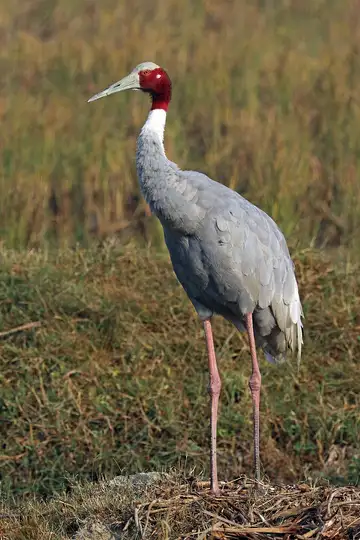
Sarus crane. (0.04 kg vs 7.3 kg) Sarus crane →
More like this
.jpg)
Sources
Updated: 2026-10-14