
Great hornbill
왕코뿔새
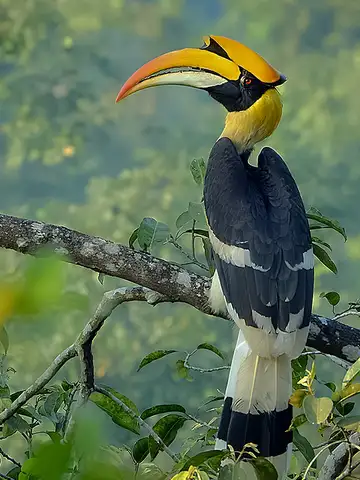
A hornbill with a huge yellow bill topped by a U-shaped casque, and a white tail with a black band. It nests in tree holes: the female is sealed inside with mud while the male brings her food.
See it on the 3D globe →At a glance
- Class
- Birds
- Lives in
- Evergreen forests of the Western Ghats in India and Southeast Asia
- Diet
- Eats both plants and meat (omnivore)
- Weight
- about 3 kg
- Length
- about 1.1 m
- Conservation status
- Vulnerable (IUCN VU)
- Habitat
- rainforests, forests
Quick answers
Where does the Great hornbill live?
It lives in rainforests, forests. On the globe you can find it near Evergreen forests of the Western Ghats in India and Southeast Asia.
How big is the Great hornbill?
It grows to about 1.1 m and 3 kg.
What does the Great hornbill eat?
Its diet: eats both plants and meat (omnivore).
Is the Great hornbill endangered?
It is listed as Vulnerable (IUCN VU).
The great hornbill is one of the biggest hornbills, a bird family known for huge curved bills. It is about 95 to 130 centimetres long, with a wingspan of around 150 centimetres, and it is the heaviest of the typical hornbills. Its bright yellow bill is topped by a U-shaped, hollow growth called a casque.
It lives in evergreen forests in India and Southeast Asia, including the Western Ghats. It mostly eats fruit but will also catch small mammals, reptiles and birds. The IUCN lists it as Vulnerable. It has been known to science since 1758, when the Swedish naturalist Carl Linnaeus described it, and its name bicornis means two-horned.
A nest sealed with mud
When it is time to nest, the female enters a hollow in a big tree. She and the male close the entrance with mud, leaving only a narrow slit.
While she looks after the eggs and chicks inside, the male brings her food through the slit. Sealing the hole keeps predators out. The female stays inside for weeks, and the male has to find enough food for the whole family.
Fruit eater and forest gardener
Hornbills swallow whole fruits and spread the seeds across the forest, so they help new trees to grow. Large trees with natural holes are important for their nests, which is why cutting down old forest hurts them.
Because the great hornbill is so striking, it matters in the culture of many local peoples. It is the state bird of Kerala and of Arunachal Pradesh in India, and one has lived nearly 50 years in captivity. Females are smaller than males, with bluish-white eyes where males have red ones.
Fun facts
- While nesting, the female seals herself inside a tree hollow with mud, and the male feeds her through a narrow slit.
- The female seals herself inside a tree hollow while nesting.
- Males have red eyes, females bluish-white ones.
- The casque on its bill is hollow.
On the globe
The globe places the great hornbill in the Western Ghats and Southeast Asian forests. Look for the huge yellow bill with the casque on top.
Quiz time
Which is heavier: Great hornbill or Indian peafowl?
Show the answer
Indian peafowl. (3 kg vs 4.2 kg) Indian peafowl →
More like this

Sources
Updated: 2026-10-14