
Giant pangolin
큰천산갑
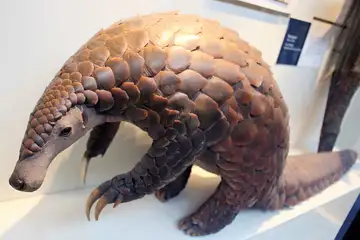
The largest pangolin, reaching about 1.4 m including the tail and about 30 kg. Its body is armoured with overlapping keratin scales, and it licks up ants and termites with a long tongue. When threatened it curls into a ball.
See it on the 3D globe →At a glance
- Class
- Mammals
- Lives in
- Central and West African rainforest and savanna
- Diet
- Insect eater
- Length
- about 1.4 m
- Conservation status
- Endangered (IUCN EN)
- Habitat
- rainforests, savannas
Quick answers
Where does the Giant pangolin live?
It lives in rainforests, savannas. On the globe you can find it near Central and West African rainforest and savanna.
How big is the Giant pangolin?
It grows to about 1.4 m.
What does the Giant pangolin eat?
Its diet: insect eater.
Is the Giant pangolin endangered?
It is listed as Endangered (IUCN EN).
The giant pangolin is the largest of all pangolins. It lives in Africa along the equator from West Africa to Uganda, mainly in savanna, rainforest and forest where there are plenty of termites and some water. One specimen weighed 30 to 40 kilograms. Males are about 137 to 180 centimetres long, and females 112 to 137 centimetres.
Like all pangolins it is armoured with large brown or reddish-brown scales made of keratin, the same material as our fingernails, and curiously it also has eyelashes. It has a long snout, a thick tail and big front claws. It has no teeth, so it can eat only soft food: nearly all its diet is ants and termites.
How does it eat?
The giant pangolin is nocturnal and usually solitary, so it is hard to watch. It finds nests by smell and tears open ant hills and termite mounds, whether underground or standing mounds. Adults lean on a mound and rest their weight on the tail while they rip into it with the front claws, which partly collapses it and exposes the termites. A pangolin cannot chew, so it licks up its prey with its long tongue.
How does it move and protect itself?
The animal walks with most of its weight on its rear legs. It curls its front paws and walks on the outside of the wrists, which protects the claws. Unlike the ground pangolin, it does not walk upright on two legs. If threatened, it rolls into a ball, as our card says. It is found at the highest known altitude of 2,466 metres in western Kenya, where a few sightings occurred.
Fun facts
- Pangolins are the only mammals covered in scales, made of keratin like our fingernails.
- Pangolins are the only mammals covered in scales.
- Its scales are made of keratin, like fingernails.
- It has eyelashes, which is unusual among scaly animals.
On the globe
The toy model of the giant pangolin walks in Central and West African rainforest and savanna. Look for the overlapping scales.
Quiz time
Which is longer: Giant pangolin or Bonobo?
Show the answer
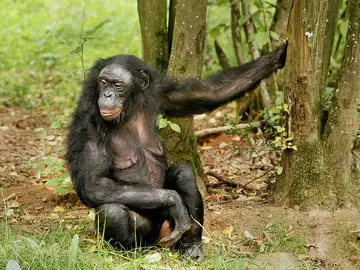
Giant pangolin. (1.4 m vs 0.77 m) Bonobo →
More like this

Sources
Updated: 2026-10-14